B2B Customer Acquisition Strategy Playbook for SaaS
You've tried LinkedIn posts, cold email, and paid campaigns, but pipeline still arrives in bursts. One month produces a few promising conversations, the next produces low-quality form fills and silence. The problem usually isn't a missing tactic. It's that the tactics aren't connected to a clear buyer, a realistic funnel, or a repeatable operating rhythm.
A practical B2B customer acquisition strategy starts with a narrower question than “Which channel should we use?” It asks which accounts are likely to buy, who must agree internally, where those people research solutions, and how the team will identify the exact point where prospects stop moving. That matters in a market where the average B2B SaaS customer acquisition cost is reported at $702, enterprise SaaS acquisition can reach $1,200 to $2,000, and the average sales cycle is 134 days, according to recent B2B acquisition benchmarks.
Table of Contents
- Why Most Early Stage Acquisition Efforts Stall
- Defining Your Ideal Customer and Buying Committee
- Choosing Acquisition Channels That Fit Your Budget and Motion
- Designing a Funnel That Converts Traffic Into Customers
- Turning Reddit Conversations Into Predictable Pipeline
- Measuring Testing and Scaling What Works
Why Most Early Stage Acquisition Efforts Stall
A typical stall looks productive on paper: 200 cold emails sent, 12 replies, two meetings, and no qualified pipeline because the ICP was defined as any SaaS company with 50 or more employees. The founder then adds LinkedIn posts and retargeting, while marketing reports clicks and sales reports conversations. Nobody can explain which investment should create the next opportunity.
The failure sits in the operating design. Teams send traffic to a message that does not reflect a real buying trigger, route every response to sales, and treat a lead as progress before confirming fit, urgency, or access to the decision group. Response volume rises while the path to revenue remains unclear.
The economics punish that ambiguity. Only 5% of B2B buyers are actively in-market at a given time, and only 5% to 20% of new leads become sales, according to the B2B customer acquisition statistics summary. A campaign can reach a large audience and still miss the small group with a current problem. Even a targeted campaign can stall when its message addresses one researcher but ignores the colleagues who evaluate risk, approve budget, or control implementation.
The three conditions for repeatability
A repeatable B2B customer acquisition strategy requires three operating decisions:
- A focused ICP: Specify the accounts with a painful problem, a credible reason to act, and a strong likelihood of retaining the product.
- Channel fit: Choose channels according to buyer behavior, sales motion, budget, and the team's capacity to maintain them. A channel also needs to be discoverable during self-directed research, including the Reddit discussions and other sources that buyers or AI tools may surface.
- Measurable funnel math: Track how qualified visitors become leads, opportunities, and customers. Fix the stage creating the largest commercial leak before adding more volume.
Owned properties matter because buying committees often investigate without a salesperson. Email is used by 79% of B2B marketers, websites by 73%, and organic social media by 55%. 39% name their own website as the most effective customer acquisition method, according to B2B lead generation benchmarks. These figures do not justify copying a channel mix. They support building pages, proof, comparisons, and answers that help several stakeholders evaluate the same purchase independently.
Practical rule: Before adding a channel, state which buyer it reaches, what intent it captures, and which funnel stage will prove its value.
Budget discipline sets the test size. 43% of B2B marketers cite limited budget as a major obstacle, according to the benchmark report. Early-stage teams should run fewer experiments, define the evidence required to continue each one, and give promising channels enough consistency to separate poor fit from weak execution. A resource on how to optimize CAC in Salesforce can help connect acquisition spending with CRM reporting instead of leaving economics in separate spreadsheets.
Defining Your Ideal Customer and Buying Committee
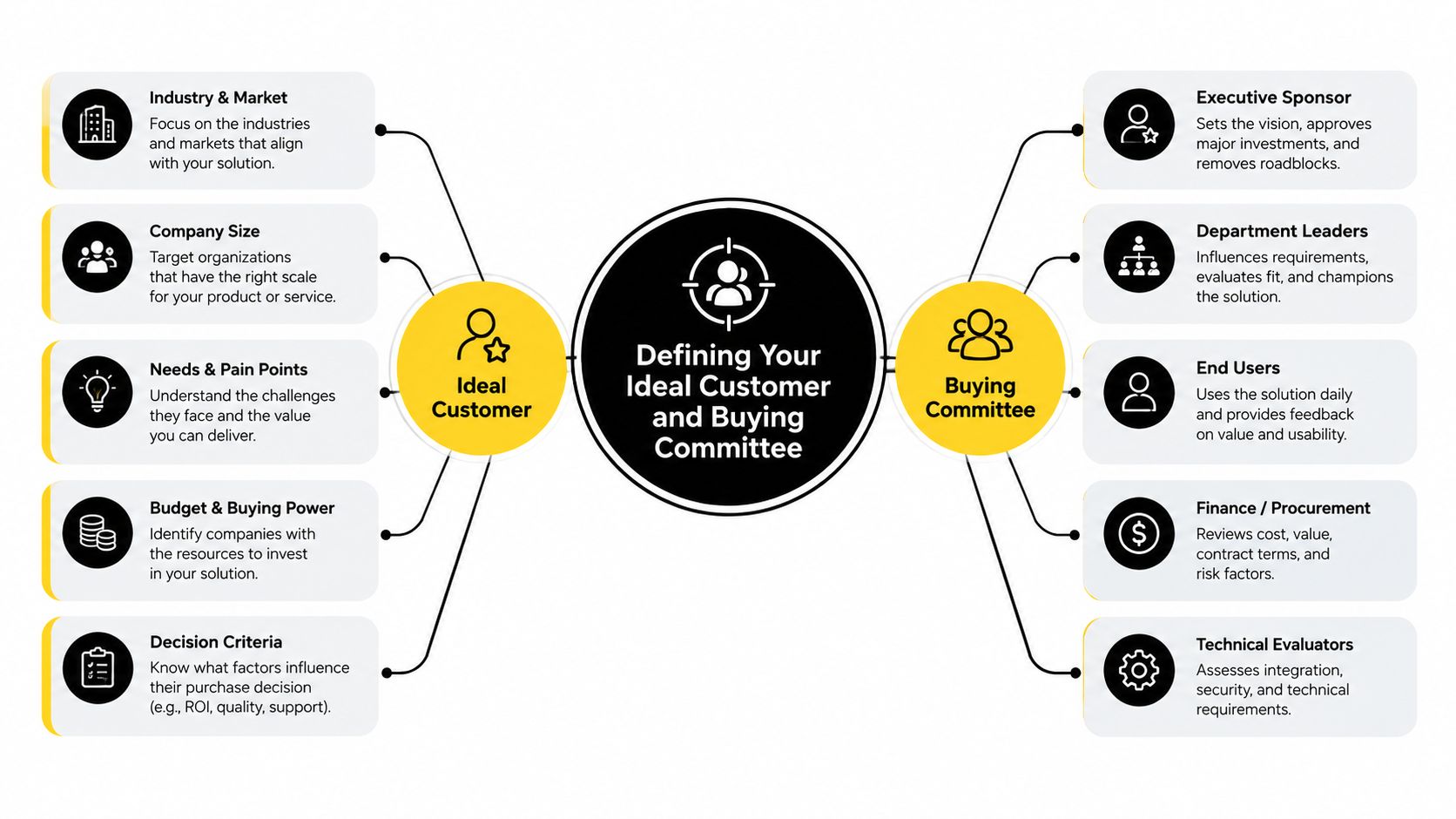
A channel can produce activity while attracting accounts that never reach a buying decision. Define the account, the trigger, and the people who must agree before you spend on acquisition. An ICP should combine firmographics, operating conditions, pain, buying signals, and the evidence that your product can create value. “Growth-stage SaaS companies” is a market label, not a usable account filter.
Start with customers who adopted quickly, reached value without unusual support, renewed, expanded, or referred others. Compare their industry, team structure, workflow, technology, urgency, and the person who first identified the problem. Pre-revenue teams can use interviews and observed buying behavior, while marking assumptions clearly so each one becomes testable.
Use this guide to the steps to define your ICP as a starting framework, then reduce the output to one page. Include target account characteristics, disqualifiers, trigger events, and the outcome your product improves. A useful ICP should help marketing choose accounts, help sales prioritize conversations, and help content answer the questions buyers ask before contacting anyone.
Build the committee map
The first lead rarely represents the complete purchase. Forrester-linked B2B buying research reports that 73% of purchases involve three or more departments, with an average of 13 people inside the buyer's organization and nine external participants. That buying group changes the acquisition task. Your content and conversations must help several stakeholders reach agreement during a largely self-directed journey.
Map the roles that can advance or block the deal:
- Economic buyer: Controls budget and needs a credible business case.
- Champion: Feels the operational pain and carries the project internally.
- Users: Judge workflow fit, usability, and adoption requirements.
- Technical or security reviewers: Examine integration, privacy, risk, and implementation.
- Procurement or legal: Check commercial terms and internal process.
For each role, record the problem they recognize, proof they require, objection they may raise, and asset or conversation that addresses it. A finance leader may need payback logic. A practitioner may need workflow detail. One feature-led message rarely creates consensus across both.
Connect account characteristics with human behavior. A customer segmentation framework can organize firmographic, behavioral, and needs-based signals, but only create groups your team can activate. Keep the segments few and meaningful. Write one value proposition sentence for each committee role, then test whether the message helps that person share the purchase internally.
The acquisition unit in complex B2B isn't the lead. It's the account's shared decision.
Choosing Acquisition Channels That Fit Your Budget and Motion
Channel choice should follow the buying committee's research habits, sales motion, and available capacity. Compare intent, feedback speed, resource demand, and scalability. A channel that attracts one interested contact may still underperform if it cannot help several stakeholders build confidence during a self-directed buying journey.
Adoption does not equal fit. Score each channel against the problems your committee roles investigate, the time required each week, the quality of feedback it produces, and the sales context needed for follow-up. Choose two channels with different strengths, then give each a clear owner and a measurable job.
| Channel | Typical Use and Intent Level | Best Fit Motion | Resource Requirement |
|---|---|---|---|
| Direct education and outreach, with intent ranging from low to high | Defined ICP with a clear pain or trigger | Research, copy, deliverability, follow-up | |
| Website and SEO | Capture self-directed research around problems and solutions | Buyers who investigate before speaking with sales | Content, technical SEO, conversion optimization |
| Face-to-face events | Build trust and qualify concentrated interest | Complex offers with relationship-led sales | Events, travel, preparation, follow-up |
| Organic social | Demonstrate expertise, proof, and repeated exposure | Founder-led or category-building motions | Consistent publishing and audience engagement |
| Direct mail | Earn account-level attention from named prospects | Mid-market and enterprise ABM | Creative, list quality, fulfillment |
| Telemarketing | Qualify quickly and surface objections directly | Teams with clear scripts and reachable buyers | Calling capacity, training, compliance |
| Reddit and communities | Answer active problems in threads that can remain searchable | Products with visible pain points and transparent expertise | Monitoring, helpful participation, moderation awareness |
| ABM | Coordinate account engagement around intent signals | Mid-market and enterprise sales motions | Account research, orchestration, sales alignment |
For a lean team, pair one direct channel with one owned or discoverable channel. Targeted email or calling can reveal objections quickly. SEO, a focused website path, or useful Reddit participation can create assets that prospects find without a sales touch. Reddit deserves a specific test because strong answers may surface in search results and AI-generated recommendations, extending their value beyond the original thread. Participation still has to serve the question first. Product promotion without useful context rarely earns trust.
ABM becomes more useful as deal values, buying groups, and sales complexity rise. Independent 2026 sources report ABM allocation at 28.4% of B2B marketing spend, intent data used by 91% of practitioners, and a 171% qualified-pipeline lift for mature programs compared with matched non-ABM controls, according to ABM benchmark research. These are reported benchmarks, not a forecast for a new program. Named-account focus can still make economic sense when several stakeholders influence one deal and broad reach produces weak sales conversations.
Test each channel against committee-level outcomes, not surface activity. Track whether the channel reaches the intended role, creates a qualified conversation, supplies evidence that another stakeholder can share, and produces opportunities at an acceptable cost. A practical guide to reducing customer acquisition costs can help when comparing those economics.
Add a third channel only after the first two have a documented audience, message, owner, and measurement process. Otherwise, expansion spreads attention before the team knows which part of the system is producing demand.
Designing a Funnel That Converts Traffic Into Customers
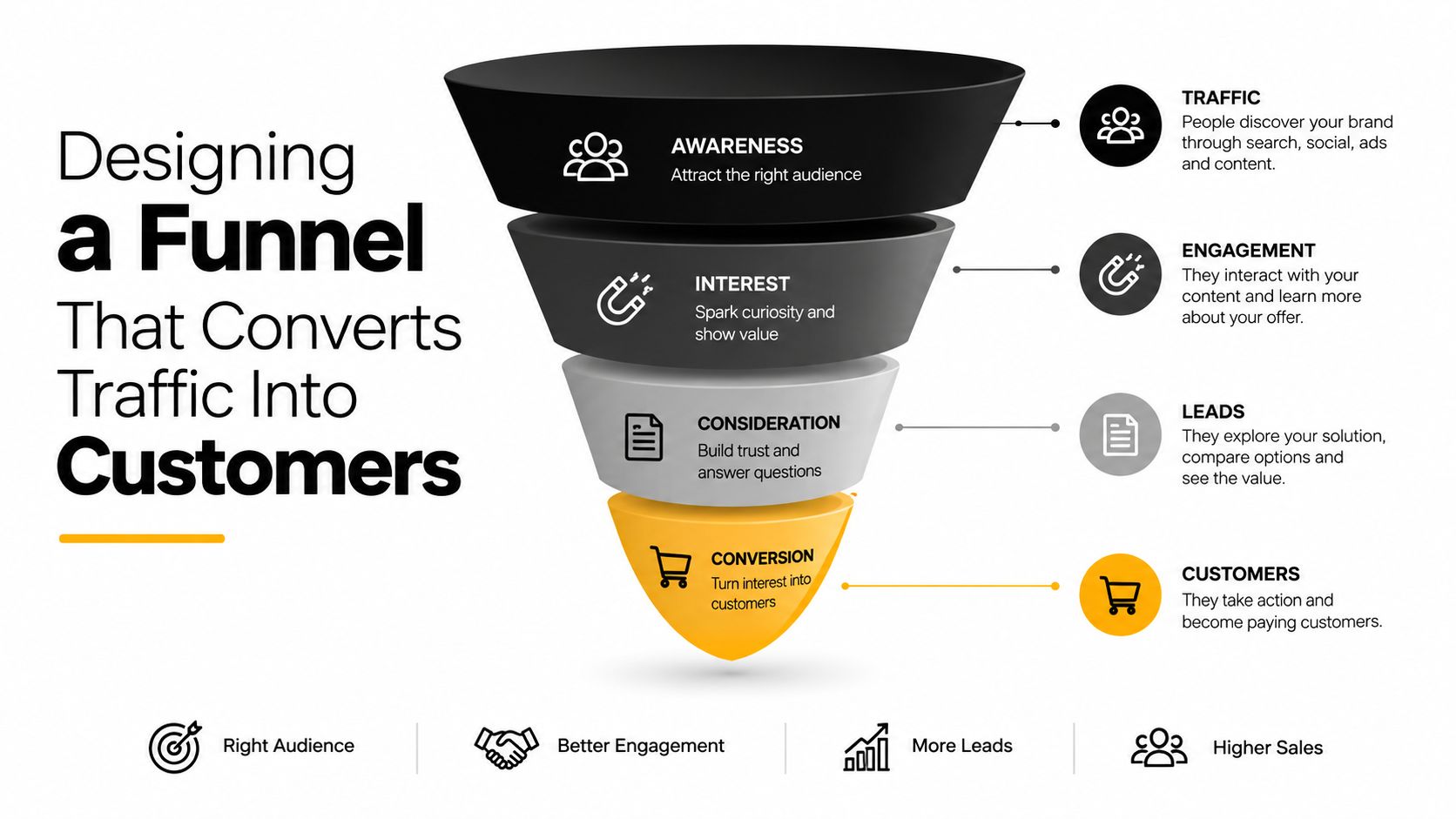
If 1,000 visitors produce 20 leads but only one opportunity, the leak is not necessarily sales follow-up. The funnel needs to show whether the problem is traffic quality, message match, qualification, or committee progression. Build each stage around the buyer's decision and assign it a measurable event.
Start with qualified discovery. The visitor should reach a page that matches the problem, audience, and intent behind the source. Someone searching for implementation guidance needs a different next step from an account executive who clicked a product comparison page. Sending both to the same demo form creates friction and weakens the signal.
Use conversion math as a diagnostic
Recent B2B benchmarks place visitor-to-lead conversion at 1.4% to 2.3%, lead-to-customer conversion at about 2% to 5%, and overall lead-to-customer conversion near 2.7% in SMB markets and 1.3% in enterprise markets, according to B2B lead conversion benchmarks. Use these ranges as diagnostic reference points, not targets to paste into a forecast.
Trace the journey in sequence:
- Qualified traffic: Check whether the source reaches the ICP and reflects a commercially relevant problem.
- Visitor-to-lead: Improve message match, page clarity, proof, form friction, and the next action.
- Lead qualification: Separate research activity from a credible project using explicit criteria.
- MQL-to-SQL handoff: Give sales the account context, role, trigger, content consumed, and stated need.
- Opportunity progression: Equip the buying committee with implementation details, commercial justification, security answers, and evidence.
- Customer conversion: Make the final step operationally clear, with owners, timing, and procurement support.
Published benchmarks put MQL-to-SQL conversion around 13% and opportunity-to-customer conversion at 22% to 30%, from the same source. If visitor-to-lead performance is weak, sales optimization will not compensate. If MQL-to-SQL is weak, review qualification and handoff before generating more leads.
A committee-aware funnel tracks account engagement alongside contact conversion. Record which roles interacted, which objections remain unresolved, and whether the champion has an internal business case. One contact downloading a guide does not equal account-level buying momentum.
Keep each landing page focused on one promise, one audience, and one next step. Use lead magnets when they help a buyer make progress, not just to exchange a PDF for an email address. Review stage conversion weekly and investigate the largest leak first.
A useful funnel improves sales conversations as well as reporting.
Turning Reddit Conversations Into Predictable Pipeline
A buying committee rarely moves from a Reddit thread straight to a demo. One practitioner may surface the problem, another may validate options, and a budget owner may later search for proof. Treat Reddit as an entry point into that self-directed journey, then connect useful conversations to the account, role, and buying stage in your CRM.
The operating system is intent-led:
- Map the conversations: List the problems, alternatives, failed approaches, integrations, and job situations your ICP discusses.
- Choose relevant communities: Find subreddits where practitioners raise those issues, then read each community's rules before participating.
- Spot buying signals: Prioritize requests for recommendations, comparisons, implementation advice, or replacements for an existing tool.
- Write the useful answer first: Explain the trade-off, give a practical process, and mention your product only when it directly fits.
- Continue privately with permission: A DM should follow a clear signal from the prospect, not interrupt a public question with an unsolicited pitch.
- Capture account context: Record the subreddit, thread, role, problem, response, resulting visit, and conversation in your CRM.
A strong reply reads like advice from an experienced operator. If someone asks how to reduce acquisition waste, explain how to segment accounts, inspect intent, and compare stage conversion. If your product handles one part of that workflow, state the connection plainly and let the reader decide whether to investigate.
Treat discoverability as part of the return
A useful public discussion can keep attracting attention after the original exchange. Searchers may find the thread later, and AI-assisted research may reference it while a buying committee compares options. Reddit therefore adds a discoverable acquisition layer alongside direct response. Measure that layer through qualified visits, assisted opportunities, and account engagement, not comment volume.
Relevance still sets the boundary. Generic product mentions can damage credibility and violate subreddit rules. Build a small library of specific answers, review which discussions produce meaningful account activity, and remove workflows that reward posting volume without buyer intent.
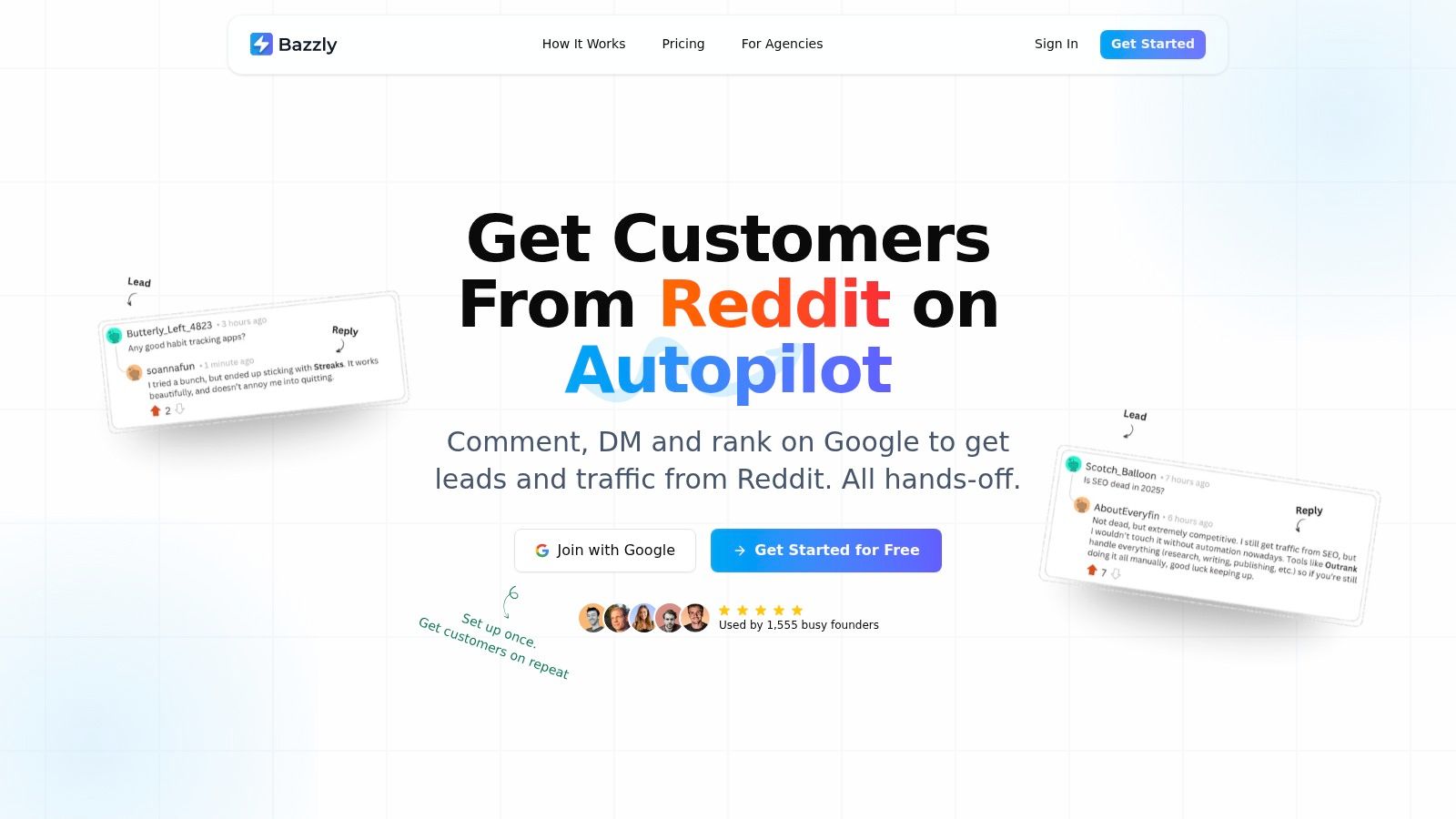
For teams without time to monitor conversations manually, Bazzly provides subreddit monitoring, high-karma aged accounts, context-aware reply drafting, smart upvotes, personalized DMs, and a Chrome extension for account control. A founder can run the workflow manually, automate discovery and drafting, or combine both. The guide to using Reddit for SaaS sales outlines a channel-specific process for turning relevant discussions into conversations without treating Reddit as a broadcast feed.
Run the process on a fixed cadence: review intent threads, approve useful responses, follow up with people who engage, and tag the account and funnel stage. Reddit becomes measurable when conversation quality connects to pipeline and committee progression.
Measuring Testing and Scaling What Works
A reliable acquisition system runs on clear measurement. Review the numbers weekly, then reconsider the system monthly. Track CAC, payback, pipeline by channel, qualified account engagement, and conversion at every stage. Keep attribution rules consistent. If one channel receives first-touch credit while another receives opportunity credit, the dashboard creates debate instead of decisions.
Run a small testing cadence
Test one meaningful variable at a time where possible:
- Message: Change the pain point, proof, audience framing, or objection addressed.
- Offer: Compare a diagnostic call, template, product walkthrough, audit, or educational resource.
- Audience: Narrow the ICP, adjust the committee role, or focus on accounts showing a trigger.
- Channel execution: Change the subreddit set, landing page intent, email sequence, or sales handoff.
- Conversion path: Reduce form friction, add role-specific proof, or give buyers a self-serve next step.
Judge each test by downstream quality. A reply, click, or form submission matters only when it leads to a qualified conversation, opportunity progression, or revenue. Use early indicators to guide iteration, then wait for later-stage outcomes before reallocating meaningful budget. Long sales cycles make quick conclusions unreliable.
Account-based scaling also needs restraint. If you test ABM, start with 1:few on 15 named accounts showing intent signals. Measure opportunity win rate against your baseline for 60 days. Expand to 1:1 only when the expected deal value justifies the research and personalization cost. This creates a practical test of account selection and effort, rather than treating benchmark performance as a forecast.
Scaling rule: Add people and budget to a proven constraint. Don't scale traffic into a page that doesn't convert or leads into a handoff sales can't process.
Use a 30, 60, and 90-day sequence
During the first 30 days, finalize the ICP and committee map, instrument the funnel, choose two channels, and establish baseline conversion. During the next 60 days, run structured message and offer tests, interview sales-qualified prospects, and remove sources that produce activity without account quality. By 90 days, commit to the channel and segment combination producing the strongest qualified pipeline, then document the process so another person can repeat it.
The operating principle is simple. Buyers research independently before sales enters, different committee members need different proof, and only part of the market is ready at a given time. Build the system around discoverability, relevance, timing, and measurable progression. Channel volume comes after those conditions work together.
Bazzly helps founders and small B2B teams monitor Reddit conversations, identify high-intent threads, draft context-aware replies, and manage personalized outreach from one workflow. Visit Bazzly to add Reddit discovery and conversation-led acquisition to your channel system.


