Community Based Marketing Guide for Early-Stage SaaS
You've found a problem people actively search for, built a product that solves it, and still watch larger SaaS companies win the buyer. Your paid campaigns bring traffic, but every click feels more expensive. Your content calendar is full, yet organic visibility takes time. Your outbound list is too small to support the volume needed for consistent results.
Meanwhile, your buyers are already describing the problem in public. They're asking for onboarding help in Reddit threads, comparing tools in Slack groups, and looking for practical recommendations in niche forums. Community based marketing turns those conversations into an acquisition workflow, provided you treat them as buying signals rather than engagement opportunities.
The mistake is approaching community as a branding ritual. Early-stage SaaS teams need a repeatable system for finding high-intent questions, answering them credibly, and creating a measured path from conversation to pipeline. That's the operating model below.
Table of Contents
- Why Community Based Marketing Matters for Early-Stage SaaS
- What Community Based Marketing Actually Is
- Community Based Marketing vs Community-Driven Growth vs Advocacy
- The Four Pillars of a Repeatable Community Playbook
- How a Single Thread Becomes a Growth Channel
- Measuring Community Based Marketing for Acquisition
- Common Misconceptions That Kill Community Programs
- Your First 30 Days of Community Based Marketing
Why Community Based Marketing Matters for Early-Stage SaaS
A founder can spend money to put a product in front of a buyer. They can't spend money to manufacture trust on demand. In crowded SaaS categories, prospects often arrive at a product page after they've already asked peers whether the category is worth exploring, which vendors are credible, and what can go wrong during implementation.
That changes the acquisition problem. You aren't only competing for attention. You're competing against established trust signals, familiar brands, and recommendations from people who appear to have faced the same problem. A paid ad may create awareness, but it rarely answers the buyer's most important question: “Has this worked for someone like me?”
Community conversations start closer to that question. Someone is already typing about a broken onboarding flow, weak product analytics, an unreliable payment process, or a painful manual task. The intent exists before you arrive. Your job is to contribute an answer that helps the person make progress, not to force a pitch into the thread.
Practical rule: Go where buyers describe the problem in their own language, then use that language to shape your answer, landing page, and follow-up.
This matters disproportionately for small teams. Paid acquisition requires budget and constant optimization. Search content requires sustained publishing and patience. Outbound requires a list, research, sequencing, and enough volume to absorb low response rates. Community based marketing still costs time, but it puts that time inside conversations where the buyer has already supplied context.
A useful operating distinction appears in this guide to online community marketing. Broad reach is not the objective. The objective is relevance at the moment of uncertainty. A thoughtful reply in a purchase-stage conversation can create more qualified attention than a large number of untargeted impressions.
That doesn't mean every Reddit comment will become a customer. Most won't. It means the channel gives a founder something paid media often can't provide: direct access to objections, vocabulary, alternatives, and the exact reasons a prospect hesitates.
What Community Based Marketing Actually Is
Community based marketing has roots in behavior-change work that emphasized participation and peer influence over one-way broadcasting. The University of Wisconsin-Stevens Point describes community-based social marketing as a research-based process that identifies barriers and benefits, selects proven behavior-change tools, pilots an intervention, and evaluates the results after implementation in its reference guide. The important lesson for SaaS founders is practical: find the friction, test an intervention, and measure behavior rather than assuming reach creates adoption.
In modern growth work, community based marketing means identifying where target buyers already gather, participating helpfully in those spaces, and connecting that participation to pipeline. The community surface might be a subreddit, a private Slack workspace, a Discord server, or a niche forum. The brand doesn't need to own the space. In fact, third-party spaces are often more useful at the beginning because members already trust the environment and its norms.
Three components make the practice operational.
Choose a defined community surface
Start with a narrow customer problem and the places where people discuss it. A good surface contains recurring questions, recognizable terminology, and enough context to distinguish curiosity from purchase intent. Reddit is especially useful when conversations are public and searchable, while Slack and Discord can offer deeper relationships inside focused professional groups.
Run a participation loop
The loop is simple, but consistency matters:
- Listen for repeated pain, objections, and product comparisons.
- Respond with a useful answer, example, teardown, or resource.
- Return to the conversation when people ask follow-up questions.
- Build in public when a recurring problem deserves a deeper explanation.
The brand should behave like a knowledgeable participant, not a publisher distributing campaign assets. Guest posts and influencer mentions borrow someone else's distribution. Community participation earns attention through contribution.
Create a trust-preserving conversion path
The conversion step usually happens after the public answer. A reader may click your profile, send a DM, ask for a template, or return to a follow-up post. That's where you can offer a product walkthrough, a relevant tool, a focused resource, or a trial that matches the problem discussed.
Referrals belong in the same system, but they need a clear exchange of value. A practical resource on reward strategies for referrals can help you design recognition or incentives without turning every interaction into a transaction.
The uncomfortable part is that public visibility and private conversion are different jobs. The thread builds credibility. The DM and follow-up turn that credibility into a qualified next step.
Community Based Marketing vs Community-Driven Growth vs Advocacy
These terms describe different growth mechanisms. Treating them as interchangeable creates confused ownership, weak reporting, and programs that try to do everything before they've proved anything.
Community-based marketing happens in communities the brand doesn't control. Marketing identifies relevant conversations, contributes to them, and measures assisted signups or pipeline influenced by those interactions. The central action is participation in an existing trust network.
Community-driven growth makes the community part of the product experience. Members create templates, integrations, workflows, feedback, and peer education that help other users adopt the product. Product or community operations usually owns the system, with member-sourced signups and activation as important measures.
Advocacy formalizes customer promotion. A customer marketing team recruits and enables existing users to provide referrals, reviews, case studies, event appearances, or public recommendations. The key metric is advocate-influenced pipeline, not just community activity.
| Dimension | Community-Based Marketing | Community-Driven Growth | Advocacy |
|---|---|---|---|
| Primary mechanism | Brand participation in third-party conversations | Member contribution improves product adoption and distribution | Customers actively promote the product |
| Typical ownership | Marketing or founder-led growth | Product, community operations, or growth | Customer marketing |
| Main KPI | Assisted signups and reply-attributed pipeline | Member-sourced signups and activation | Advocate-influenced pipeline |
| Time to first result | Often fastest when high-intent conversations already exist | Slower because the product and community loop must mature | Depends on the strength of the customer base |
| Biggest failure mode | Promotional replies that violate community norms | Building a space without a useful product habit | Recruiting advocates without giving them a reason or usable assets |
Choose one primary motion for the current stage. A new SaaS product with limited customers usually shouldn't begin with a formal advocacy program. It has too little customer evidence. It may also be premature to build an owned community before it understands where buyers naturally gather.
Start with community-based marketing when you need to learn demand language and create qualified conversations. Add community-driven growth when member contribution improves the product itself. Build advocacy when satisfied customers have enough experience to recommend the product credibly.
The Four Pillars of a Repeatable Community Playbook
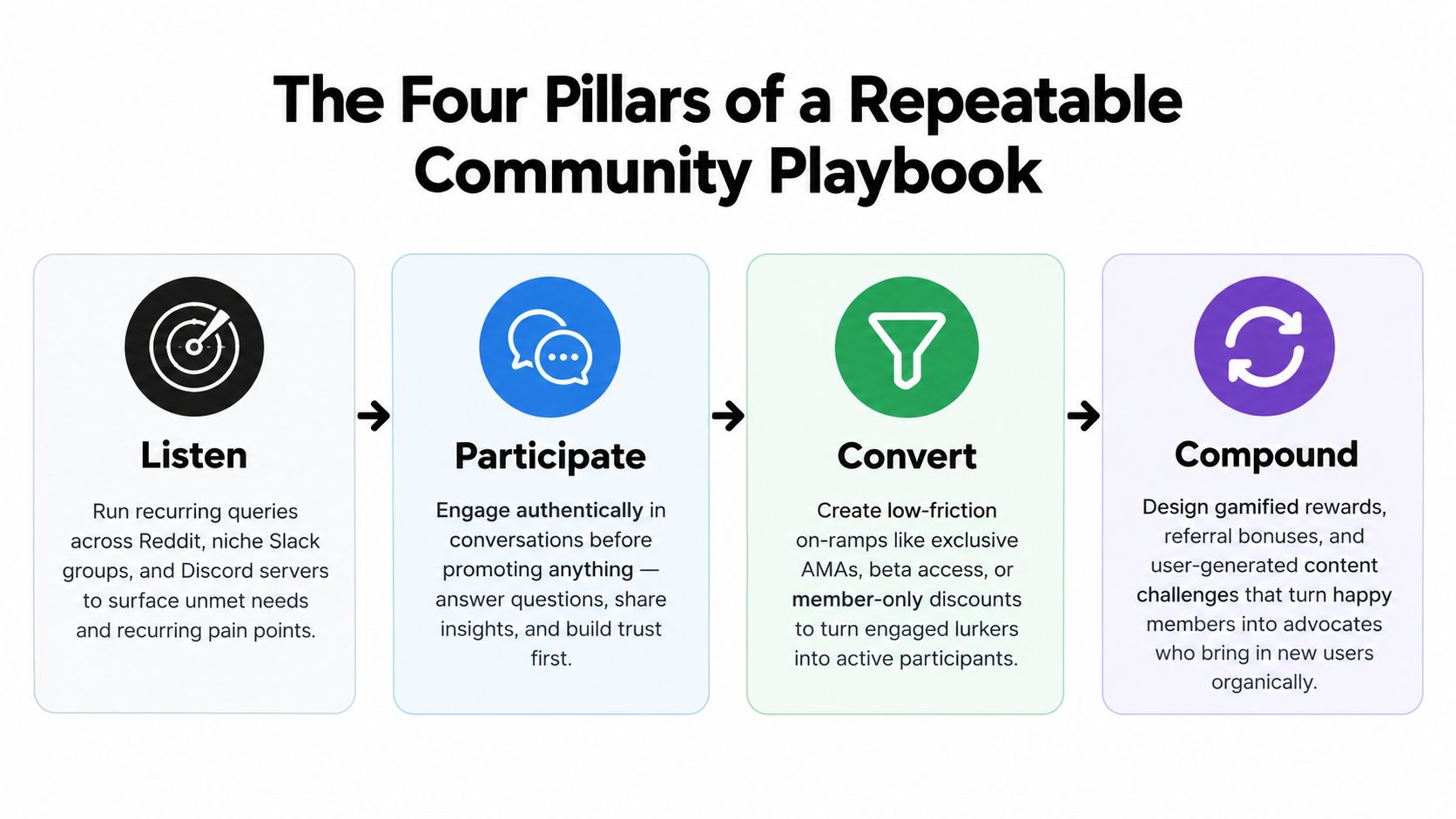
A workable system has four movements: listen, participate, convert, and compound. Skip one and the program either becomes noise, a sales channel with no trust, or a collection of isolated posts.
Listen for the language buyers repeat
Run recurring searches across Reddit, niche Slack groups, and Discord servers. Look for phrases that combine a problem with urgency, such as “how do I reduce onboarding drop-off,” “alternative to,” “recommendation for,” or “what are you using for.” Save the wording exactly. Those phrases are research inputs for replies, product messaging, and future content.
On Reddit, monitor keywords, topic patterns, and sentiment before you participate. Reddit's market research guidance supports moving from passive listening to active participation once you understand what people are discussing.
Participate before you mention the product
Answer the question asked. If someone wants a teardown, provide a teardown. If they need a comparison framework, explain the criteria. If they're troubleshooting, show the diagnostic path.
A SaaS founder in a product-led growth Slack group might share an onboarding checklist without mentioning their product. Later, when a member asks how to automate one part of that checklist, the founder can disclose their affiliation and explain where the tool fits. The disclosure protects trust. The relevance earns attention.
Convert with a low-friction next step
Don't end every reply with a generic signup link. Offer the next action that matches the thread:
- A DM: Send a specific answer when the person invites further detail.
- A public follow-up: Add a short example when several readers have the same question.
- A focused resource: Share a template, calculator, or teardown relevant to the stated problem.
- A product trial: Suggest the tool only when it directly addresses the request.
Use the internal operating notes in these community building strategies to keep the interaction useful before it becomes commercial.
Compound what earns attention
A strong answer shouldn't disappear when the thread slows down. Turn it into a detailed blog post, a Notion guide, a product education page, or a saved reference that can answer the next version of the same question. Return to the original thread when you have a meaningful update, not a forced bump.
The compound effect comes from preserving useful knowledge. One answer can serve the original poster, future readers, search visitors, and people who discover the discussion through an AI-assisted query.
How a Single Thread Becomes a Growth Channel
An indie SaaS founder notices a recurring question in r/SaaS about onboarding drop-off. The usual replies recommend adding more tooltips or sending another email. Instead of dropping a product link, the founder writes a teardown of the onboarding flow, explains where users lose context, and gives a practical sequence for diagnosing the problem.
The post attracts follow-up questions because it addresses the decision behind the tactic, not just the tactic itself. The founder replies with screenshots, clarifies assumptions, and states where the advice won't apply. That last part matters. Buyers trust useful boundaries more than universal claims.
During the first week, the author's profile receives more attention than the original product page. A few readers ask whether the founder can review their own flows. The founder answers the public questions openly, then continues the specific conversations in DMs when people request help.
By the second week, the thread begins appearing for searches related to SaaS onboarding benchmarks. That visibility creates a second audience, people who never saw the original post in their feed. Some read the discussion, inspect the founder's profile, and arrive at the product with context already established.
A follow-up comment later in the month adds a short checklist based on the questions raised in the thread. It brings the discussion back into circulation without pretending that nothing has changed. The original answer has become an asset, but only because the founder stayed present and improved it.
The thread is not the campaign. The campaign is the sequence of observation, contribution, follow-up, attribution, and reuse.
This pattern works beyond SaaS onboarding. A payments founder might answer a Discord question about handling transactions inside a community, then point readers to a technical resource such as a card and crypto payment bot when the use case matches. The link is useful because it extends the answer. It fails if it replaces the answer.
Don't promise yourself that one post will transform acquisition. Build a library of high-quality responses around a narrow buyer problem. The compounding comes from repeated relevance, not from chasing a viral moment.
Measuring Community Based Marketing for Acquisition
A community program becomes defensible when you can connect a conversation to a commercial action. Upvotes, comments, and impressions can indicate that a post traveled, but they don't tell you whether the audience had a problem your product solves.
Track the path from community source to qualified action. Create a distinct UTM for each community and thread, use CRM fields for platform and conversation ID, and record whether the touchpoint came from a public reply, profile visit, or DM. Keep the first version manual. Accuracy matters more than automation while you're still learning which signals deserve attention.
Use acquisition-grade replacements
| Vanity Metric | Acquisition-Grade Replacement | How to Track |
|---|---|---|
| Upvotes | Assisted signups | Record the thread URL in the CRM source field and compare visits with completed signups |
| Comment volume | Reply-attributed demos | Tag conversations that lead to a booked demo or qualified sales conversation |
| Impressions | Qualified profile visits | Use platform analytics alongside tagged profile links and landing-page sessions |
| Follower growth | DM-to-trial rate | Log initiated DMs, invited trials, and completed trial starts |
| General engagement | Reply-attributed CAC | Divide fully loaded community time by trials sourced from tracked conversations |
| Broad referral activity | Community-touchpoint LTV comparison | Compare downstream customer value for community-sourced and paid-search cohorts |
Reply-attributed CAC forces an honest accounting. Include the founder's or operator's time, moderation and monitoring tools, content reuse, and follow-up. Then compare that total with the number of qualified trials or opportunities that originated from tracked replies.
For SaaS, also monitor assisted signups and pipeline influence. A community touchpoint may not receive last-click credit if someone reads a Reddit answer, returns through branded search, and signs up later. That's why source history and a simple first-touch or assisted-touch convention matter.
The SaaS marketing ROI framework can help connect channel activity to commercial outcomes rather than reporting attention in isolation. Review every community by signal quality:
- High signal: People describe an urgent problem, ask for vendor recommendations, or request implementation help.
- Medium signal: Members discuss workflows and tools but show no immediate buying intent.
- Low signal: The space generates activity without meaningful problem-specific conversation.
A small high-signal community deserves more attention than a busy channel full of passive reactions. Review the score weekly and stop investing in conversations that create no qualified movement.
Common Misconceptions That Kill Community Programs
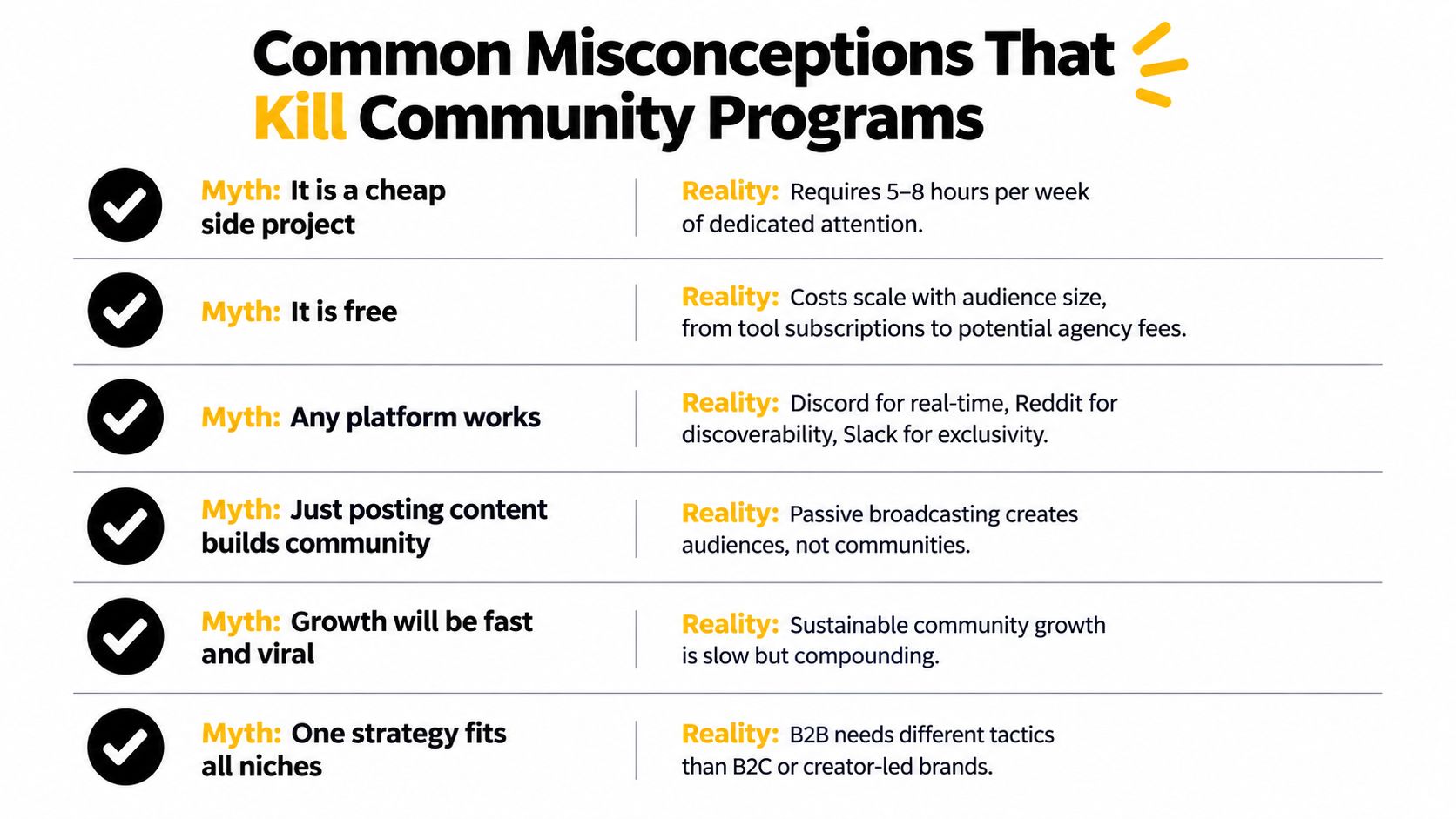
Community based marketing isn't a free side project. It uses founder attention, moderation effort, tooling, and the opportunity cost of work you didn't do elsewhere.
The program also shouldn't inherit the vague reporting language of brand marketing. If the team celebrates impressions while no one records replies, DMs, trials, or pipeline, the program is producing activity without evidence.
The cost is attention
A founder-led program may require 5 to 8 hours per week of dedicated work, as specified in the operating plan for this guide. That time covers monitoring, writing, replies, follow-up, logging, and repurposing. Tool subscriptions add cost, and the work may eventually require a community lead.
The tradeoff is real. Every hour spent answering a thread is an hour not spent on outbound, product work, customer calls, or support. Set a weekly capacity limit before you start, then judge the channel against qualified outcomes rather than emotional satisfaction.
Authenticity can't be delegated casually
Contractors can help with research, formatting, and logging. They shouldn't impersonate the founder's judgment or publish generic replies without product and customer context. A polished answer that sounds unlike the people in the community can damage credibility faster than silence.
The strongest moat is first-party authorship plus disciplined measurement. The founder knows which objection is real, which implementation detail is painful, and which promise the product can't safely make.
A community program without a documented playbook, a named owner, and a weekly review cadence isn't a strategy. It's a hobby with a Slack bill.
Your First 30 Days of Community Based Marketing
Start narrow. Your first month should prove whether a specific buyer problem creates conversations and qualified actions, not attempt to establish a presence everywhere.
Week one
Map 8 to 12 high-intent subreddits and 3 to 5 Slack or Discord communities where your buyers ask purchase-stage questions. Record the community, rules, recurring phrases, moderators, and examples of useful contributions. Create a spreadsheet with the thread URL, author, problem category, reply date, profile link, UTM, and outcome.
Don't automate yet. Read enough conversations to understand tone and self-promotion rules. Your first deliverable is a ranked list of problems, not a pile of scheduled posts.
Week two
Publish two substantive contributions with no product plug. Use a teardown, template, checklist, or contrarian explanation. Reply to every comment within four hours when possible, and record which questions reveal urgency or buying intent.
Track profile visits, DMs, assisted signups, and the language people use in follow-ups. If no one asks for more detail, improve the problem selection before increasing output.
Week three
Select the five highest-intent threads from the first two weeks. Answer them directly and mention your product only when it solves the exact problem raised. Disclose your affiliation, explain the relevant feature, and provide an alternative when your product isn't a fit.
Keep DMs manual until the conversation pattern is clear. Start automating UTM capture or monitoring only after you have enough repeated activity to make the workflow stable. For a solo founder, the threshold should be operational rather than arbitrary: automate when manual logging consistently causes missed replies or takes more time than writing the answers.
Week four
Repurpose the strongest answer into a durable resource. Return to the original thread with a meaningful update, then review community performance on Friday.
Your weekly scorecard should include:
- Assisted signups: Which conversations preceded a signup?
- Reply-attributed demos: Which replies created qualified sales activity?
- DM-to-trial rate: Which private conversations moved to trial?
- Time per qualified action: How much operator time produced each meaningful outcome?
- Signal quality by community: Which spaces contain the strongest buying intent?
If you want to reduce the manual search and monitoring burden, Bazzly helps founders identify relevant subreddits and high-intent Reddit threads, then draft or publish context-aware replies with controls for tone and targets. Visit Bazzly to see how it can fit into a measured community acquisition workflow, while keeping your tracking and judgment in the loop.