SaaS Lead Generation That Builds Predictable Pipeline
Most founders think SaaS lead generation is a traffic problem. Usually, it isn't.
A benchmark summary for B2B SaaS puts the median visitor-to-lead conversion rate at 2.8%, lead-to-MQL at 34%, MQL-to-SQL at 19%, SQL-to-opportunity at 61%, and opportunity-to-closed-won at 24%, which compounds to just a 0.95% lead-to-closed-won rate according to Digital Applied's 2026 benchmark summary. That single number changes how you should think about pipeline. If your funnel leaks at every step, more traffic just feeds a leaky system.
That's why smart SaaS teams don't treat lead generation as a bag of tactics. They treat it as a conversion system. Traffic matters, but intent, routing, qualification, and follow-up matter just as much. In many cases, they matter more.
Table of Contents
- Why SaaS Lead Generation Feels Harder Than It Should
- How SaaS Lead Generation Really Works
- Core Channels That Drive Qualified SaaS Leads
- A Repeatable Framework for Building Pipeline
- Emerging Opportunities on Reddit and AI Discovery
- Metrics That Prove Your Lead Generation Is Working
- Your Next Moves for Predictable SaaS Growth
Why SaaS Lead Generation Feels Harder Than It Should
A benchmark summary cited earlier found that only a small share of B2B SaaS leads become real sales opportunities. That drop-off is why lead generation feels harder than the traffic numbers suggest.
Founders usually notice the symptom first. Site visits go up, demo requests trickle in, and revenue still feels uneven. The problem is rarely one big failure. It is a chain of small breakdowns between stages.
A lead generation system works like a set of connected pipes. If pressure drops in one section, the faucet at the end never delivers much, even if plenty of water entered at the start. SaaS pipeline behaves the same way. One visitor leaves without converting because the page does not match their intent. Another fills out a form but is a poor fit. Another requests a demo and cools off because the team responds too slowly.
Those are three different problems. They need three different fixes.
More activity does not guarantee more pipeline
A lot of advice still points founders toward volume. Publish more content. Run more ads. Send more outbound. Those tactics can create attention, but attention alone does not create qualified pipeline.
Lead generation sits inside the larger system of SaaS marketing strategy and execution. It connects demand creation to sales conversations. If that connection is weak, extra traffic behaves like extra people entering a store with no checkout counter. The room looks full. Revenue does not follow.
This is why lead generation often feels confusing. Teams lump very different failures into one bucket and call all of them a lead problem.
Why the old volume playbook breaks down
Buying weak-fit leads gets expensive fast. A benchmark roundup from The Insight Collective notes a median SaaS CAC payback period of 17 months. That kind of payback window leaves little room for waste. If marketing attracts the wrong accounts, or sales waits too long to respond, the economics get harder before they get better.
The same source also summarizes a large Salesforce survey showing that many marketing-qualified leads never become sales-qualified opportunities. That gap matters because it explains the day-to-day frustration founders feel. The calendar looks busy. The CRM looks active. The pipeline still does not grow at the rate the team expected.
Speed makes this worse or better. A high-intent buyer who asks for a demo is like someone walking into a store and heading straight for the register. If nobody meets them there, intent fades. Founders often blame channel quality when the issue is response time.
The mindset shift that makes lead gen easier to fix
Treat SaaS lead generation as a stage-by-stage conversion system.
Start with four questions:
- Where does buyer intent first show up?
- What qualifies someone to move to the next stage?
- How fast does your team respond when intent is high?
- Which channels bring curiosity, and which bring buying intent?
That last question matters more now. Someone clicking a broad social ad behaves differently from someone comparing vendors on Reddit, asking a product question in an AI tool, or searching for a category solution with a clear use case in mind. If you treat all leads the same, your funnel mixes low-intent research with high-intent buying behavior and hides what is working.
Founders usually do not need more names at the top. They need cleaner stage definitions, faster follow-up, and channels matched to intent. Once you see lead generation that way, the work becomes more concrete. You stop chasing raw volume and start improving conversion at each step that turns attention into pipeline.
How SaaS Lead Generation Really Works
Think of your funnel like a series of gates, not one big bucket. Every gate asks a different question.
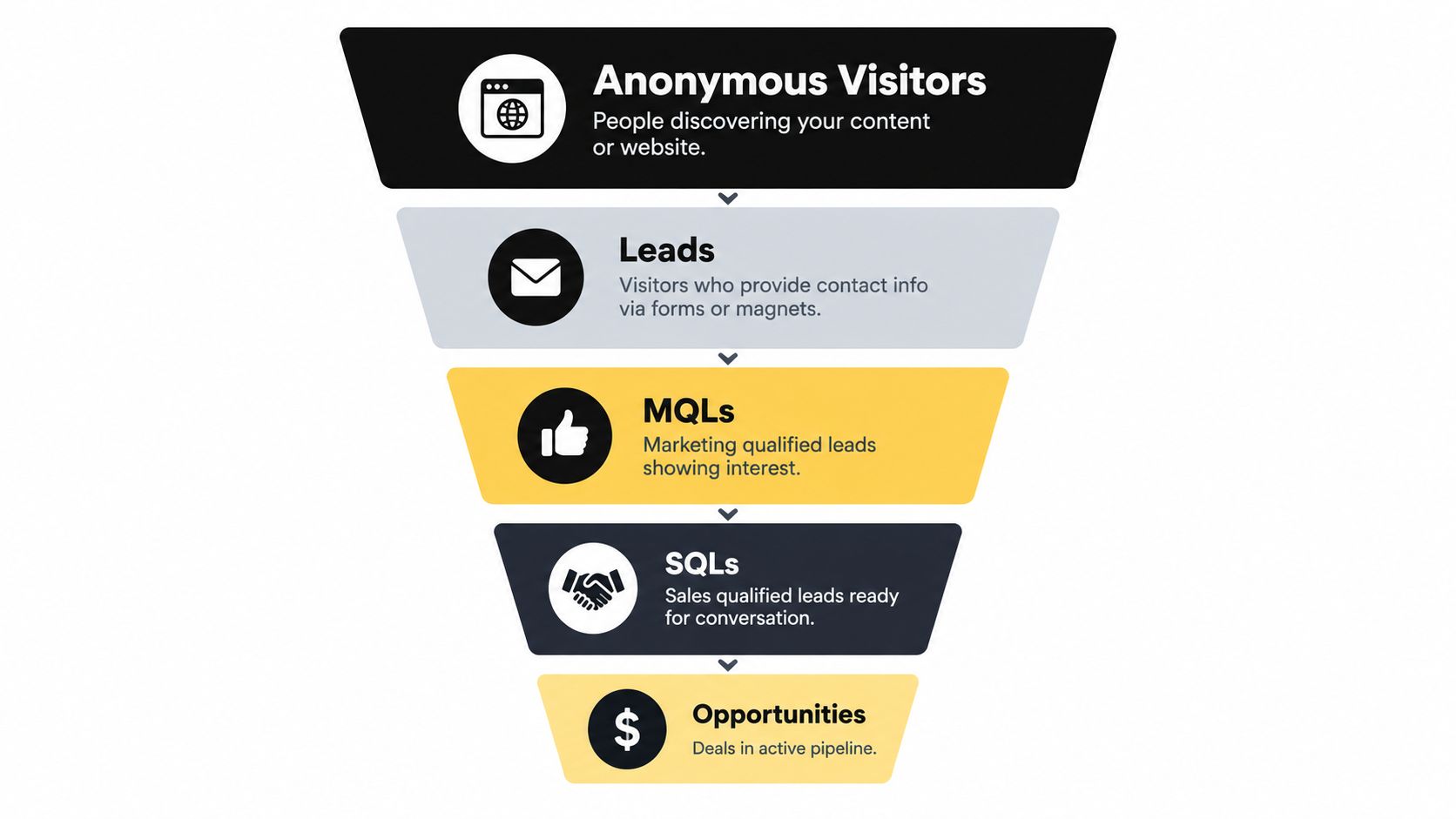
The first gate asks, “Did this person care enough to raise their hand?” The next asks, “Does this person fit our buyer profile?” Then, “Are they ready for a serious conversation?” Finally, “Can this turn into a real deal?”
Start with the simplest funnel definitions
Here's the plain-language version:
- Anonymous visitor: Someone lands on your site, reads, compares, or explores, but doesn't identify themselves.
- Lead: They fill out a form, start a trial, request a demo, or give you contact info in some other clear way.
- MQL: Marketing looks at that lead and says, “This appears to match the audience we want, and the behavior shows some interest.”
- SQL: Sales reviews it and says, “This is worth direct follow-up.”
- Opportunity: A real deal exists in the pipeline. There's a use case, a buying motion, and a path to a decision.
Most confusion comes from fuzzy stage definitions. If marketing calls almost everyone an MQL, sales stops trusting the label. If sales only accepts perfect leads, good prospects sit ignored. SaaS lead generation breaks when these definitions live in slide decks instead of daily workflows.
Qualification is the hinge
A lead isn't valuable because a form was filled out. It becomes valuable when the person has the right problem, the right context, and enough intent to continue.
That's where lead scoring, routing, and nurturing come in. Scoring helps you separate “curious” from “likely to buy.” Routing makes sure the right rep or workflow gets the lead fast. Nurturing keeps the conversation alive when someone isn't ready today but may be ready soon.
Practical rule: If sales complains about lead quality and marketing complains about follow-up, the real problem is usually stage definition plus handoff design.
Why economics force discipline
SaaS companies live with delayed payback. You spend on acquisition now, then earn back that cost over time. That's why sloppy lead gen gets expensive fast.
A benchmark summary at SaaS Hero reports that the median website visitor-to-lead conversion rate is about 1.5% to 2.5%, while top-decile performers reach 8% to 15%. The point isn't to obsess over a single benchmark. The point is that small improvements in message-market fit, intent targeting, and landing-page friction can create materially more pipeline without requiring more traffic.
A quick self-check
If you want to diagnose your funnel, ask:
- Who are we attracting? Are visitors close to our ideal buyer?
- What action are we asking for? Demo, trial, audit, template, call, or something else?
- How do we decide fit? Industry, role, team size, use case, urgency?
- Who follows up, and how fast? Many funnels fail.
- What happens to good but not-ready leads? If the answer is “not much,” nurturing is missing.
Once those answers are clear, lead generation becomes less mysterious. It turns into operations.
Core Channels That Drive Qualified SaaS Leads
Qualified pipeline usually comes from a small set of channels that match buyer intent at the right moment. A founder who treats every channel as a traffic source misses the bigger pattern. SaaS lead generation works more like a relay race. One channel starts the motion, another captures demand, and your follow-up speed decides whether the handoff turns into a meeting.
That is why channel selection should start with a sharper question than "Where can we get leads?" Ask: Where does our buyer reveal buying intent, and how quickly can we respond when they do?
Compare channels by intent, speed, and fit
Earlier benchmarks in this article already covered cost ranges across common B2B SaaS channels. Cost still matters, but cost alone hides an important distinction. A cheap lead from a low-intent source can create more work than value. A more expensive lead from a buyer who is actively comparing tools can pay back fast if routing and follow-up are tight.
Use the channel the way you would use the right tool in a workshop. A screwdriver is not bad because it cannot cut wood. It is just built for a different job. Channels work the same way.
| Channel | Typical Intent Level | Best Fit |
|---|---|---|
| Organic search | High when the query is specific | Teams building durable demand capture around problem-aware and comparison searches |
| Paid search | High when keywords are commercial | Buyers actively evaluating tools, alternatives, pricing, or migration paths |
| Content syndication | Mixed | Brands that need reach and already have strong qualification and nurture |
| Webinars | Medium to high | Products that require education, process change, or stakeholder alignment |
| LinkedIn ads | Medium | Precise audience targeting when deal size supports higher acquisition costs |
| Outbound email | Varies widely | Narrow account lists with strong personalization and clear trigger events |
| Reddit and communities | Often high when the thread is problem-specific | Small teams joining active buyer conversations with useful answers |
What each channel is actually good at
Organic search captures existing demand that buyers express in their own words. This channel tends to produce better-fit leads when your pages match painful jobs, not broad industry topics. Pages about alternatives, integrations, implementation questions, and role-specific use cases often outperform general thought leadership because the searcher is trying to solve something concrete.
Paid search is your fastest route to demand capture when people already know the category. Someone searching "best SOC 2 compliance software for startups" is giving you a much clearer signal than someone who clicked a top-of-funnel social ad. Paid search gets stronger as your team learns which queries signal urgency versus casual research.
LinkedIn ads work best when you need precision, not volume. You are paying for access to a narrow audience, so the offer has to match that level of cost. A webinar for finance leaders, a benchmark report for RevOps teams, or a diagnostic tied to a costly workflow usually works better than a generic ebook. If you want a practical breakdown of targeting, offer design, and tradeoffs, this guide to LinkedIn lead generation campaigns is a useful reference.
Webinars help when the sale requires understanding. If your product changes a workflow, touches compliance, or needs internal buy-in, a live session can move a buyer further than a landing page can. Attendance itself is also a signal. A person who gives you 30 minutes is telling you more than a form fill alone.
Content syndication can widen the top of funnel, but it often sends names before intent is clear. That is not automatically bad. It just means the channel depends on stricter qualification and better nurture than founders expect. If your team treats every syndication lead like an immediate sales opportunity, quality will look worse than it is.
Why outbound works differently now
Outbound still has a place, but the old playbook of high volume and thin context has weakened. Buyers ignore generic cold emails for the same reason users ignore irrelevant product popups. The message arrives before the need feels urgent.
Strong outbound starts with a trigger. Hiring, new funding, a tech stack change, expansion into a regulated market, or active discussion of the problem in public are all better starting points than a scraped list. The channel succeeds when the rep can answer a specific question the buyer is already likely asking.
A useful companion read is this SaaS lead generation guide, which frames channel choice around sales motion and buyer behavior rather than generic checklists.
Two channels founders underrate
Reddit and niche communities often surface pain earlier than search does. Buyers go there when they want blunt answers, workarounds, or peer advice. That makes these communities valuable for both demand capture and message research. If a thread says, "What are you using instead of X?" or "How are you solving Y without adding headcount?" the buying signal is already visible.
AI discovery is becoming a new layer on top of search and community content. Buyers increasingly ask AI tools for vendor comparisons, workflow recommendations, and summaries of what practitioners say. That shifts part of lead generation from pure ranking toward citation, clarity, and presence in the sources AI systems pull from. Pages that answer a clear use case, plus credible discussion in places like Reddit, can influence discovery before a buyer ever lands on your site.
A practical filter for choosing your first channels
Use this filter to avoid spreading effort too thin:
- Need pipeline soon: Start with paid search, bottom-funnel SEO pages, and problem-specific communities where buyers are already asking for help.
- Need durable demand capture: Build organic search around use cases, alternatives, integrations, and migration content.
- Need education before conversion: Use webinars and structured content that explains the workflow change behind the product.
- Need efficient execution with a small team: Pick one capture channel and one nurture channel. Depth beats a wide but shallow mix.
- Need better lead quality, not more names: Prioritize channels with visible intent and tighten speed-to-lead on every handoff.
The common mistake is treating channels as separate bets. They work better as stages in one conversion system. Search captures active demand. LinkedIn can put a specific offer in front of a defined audience. Reddit exposes urgent language and objections. Fast follow-up turns those signals into meetings.
A Repeatable Framework for Building Pipeline
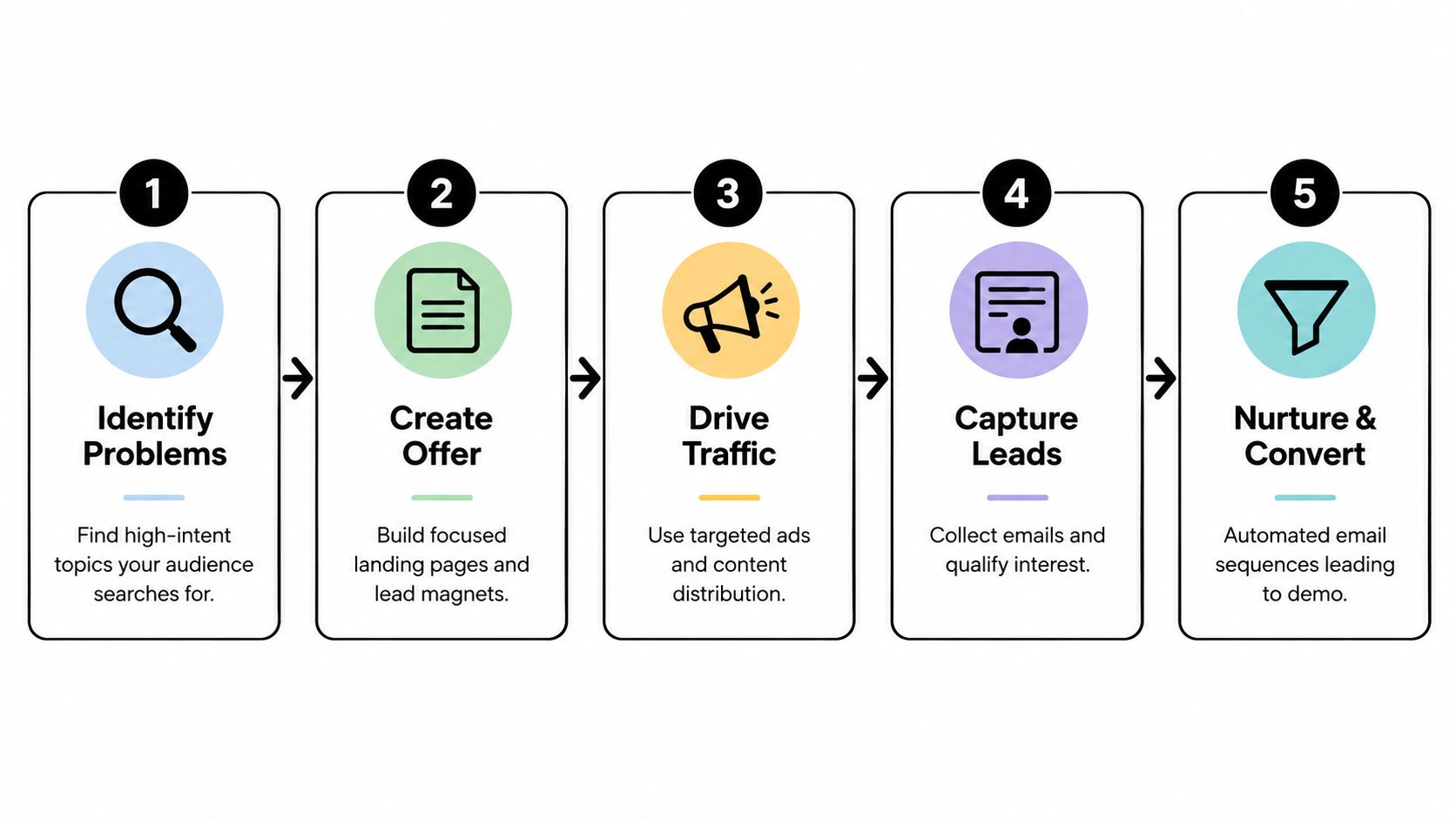
Most lead gen plans fail because they're a list of tactics without a flow. What works better is a connected system where each part prepares the next one.
The basic sequence is simple. Find urgent problems. Package a relevant next step. Capture the lead with low friction. Route and qualify quickly. Nurture with context. Hand off to sales with enough information that the first conversation feels informed, not generic.
Identify high-intent problems first
Start with the buyer problem, not your feature list.
A founder selling finance automation software shouldn't begin with “AI-powered workflow orchestration.” They should begin with problems like “month-end close takes too long” or “reconciling data across tools is error-prone.” High-intent lead generation starts where the pain is concrete and costly.
Look for signals like:
- Comparison behavior: Searches for alternatives, comparisons, or migration help.
- Workflow friction: Repeated complaints in support communities, review sites, or forums.
- Buying triggers: Hiring, tool consolidation, compliance changes, or a new internal owner.
If you want another perspective on structuring that motion from first touch to deal stages, Grou's B2B pipeline playbook is a useful complement.
Build one focused offer per intent
The next mistake teams make is sending every visitor to the same generic page. A person looking for a “HubSpot reporting alternative” and a person looking for “how to reduce sales admin time” should not hit the same conversion path.
Match the offer to the moment:
- Problem-aware visitor: Give them a focused guide, template, checklist, or practical teardown.
- Solution-aware visitor: Offer a comparison page, demo, pricing context, or use-case walkthrough.
- Product-aware visitor: Offer a trial, live consultation, or demo.
Your landing page only needs to do a few things well:
- Name the exact problem
- Show the next step clearly
- Ask for only the information you need
- Reduce uncertainty with relevant proof or explanation
Route and qualify while intent is still hot
A lot of teams collect leads well and handle them poorly. That's not a top-of-funnel issue. It's an operations issue.
The benchmark at Aloware reports an average B2B response time of about 42 hours, with only about 7% of teams replying within five minutes. The same benchmark says five-minute responders convert at roughly 21% versus about 2.3% for leads contacted after 24 hours or more, which points to a major conversion gap tied to speed.
That means your framework needs instant actions:
- Tag fit fast: Company type, role, use case, source, and urgency.
- Send the right path: Sales call for strong-fit demo requests, nurture for early-stage interest, product onboarding for trial users.
- Give context to follow-up: Include the page visited, asset downloaded, or thread engaged with.
Reply speed is part of qualification. A good lead handled slowly often behaves like a bad lead.
Nurture by problem, not by calendar
Most nurture sequences fail because they're time-based but not context-based. Sending “just checking in” emails rarely helps. Sending material tied to the buyer's exact concern often does.
Good nurture feels like guidance:
- Someone evaluating integrations gets implementation content.
- Someone worried about switching costs gets migration help.
- Someone exploring ROI gets workflows, examples, and decision criteria.
For Reddit-sourced intent, one option is using a tool like Bazzly to monitor relevant conversations, surface problem-specific threads, and help teams reply or DM with context instead of cold outreach. That kind of workflow fits small teams because it starts with visible intent rather than guessing who might care.
Hand off to sales with enough context to matter
A sales rep shouldn't have to start from zero if marketing already learned something useful.
Pass along:
- What triggered the lead
- What problem they appear to have
- What content or touchpoints they engaged with
- Whether they look urgent or exploratory
That changes the first call from “Tell me about your business” to “I saw you were comparing options for this workflow. Is that still the main issue?” Small detail. Big difference.
Emerging Opportunities on Reddit and AI Discovery
Some of the strongest SaaS buying signals don't show up in your CRM first. They show up in conversations.
A founder posts on Reddit asking for a tool recommendation. A team lead compares options in a niche community. A buyer asks an AI assistant for the best software for a specific use case, then follows the sources it surfaces. Those moments are easy to miss if your lead gen system only watches forms and ad clicks.

Why Reddit often signals real intent
Reddit matters because people use it differently from polished social platforms. They ask blunt questions. They describe actual constraints. They say what they tried and why it failed.
A thread like “What tool are you using for client onboarding in a small agency?” carries more buying intent than a broad thought-leadership post. The person isn't browsing inspiration. They're trying to solve a job.
That changes how you should participate:
- Answer the question directly
- Share tradeoffs, not hype
- Mention your product only when it clearly fits
- Write like a practitioner, not a campaign
For teams trying to understand how Reddit answers can influence broader discovery, this guide on getting SaaS into ChatGPT answers through Reddit is worth reviewing.
AI discovery is changing where leads begin
Another shift is happening one step earlier. Some buyers now start research inside AI tools before they ever visit your site.
A recent summary from Zappiq AI reported that ChatGPT referral traffic hit an all-time high in May 2026 and that qualified lead quality from ChatGPT-referred calls was measured at 49%, higher than the cross-channel average. The exact mechanics will keep changing, but the behavior signal is already clear. Buyers are using AI-assisted discovery to shortlist vendors and evaluate options.
That creates a practical question: what content gets surfaced?
Often, it's not generic homepage copy. It's specific pages, relevant community discussions, comparison content, and threads that clearly answer a use case.
The new discovery path is often conversation first, website second.
A practical scenario for small teams
Say you sell a lightweight CRM for agencies.
A traditional playbook might tell you to run broad outreach, publish general blog posts, and boost a LinkedIn ad. A more intent-driven playbook would do something else. You'd monitor Reddit threads where agency owners ask about client follow-up, proposals, and pipeline visibility. You'd publish pages that answer comparison and setup questions clearly. You'd make sure those pages are useful enough to be cited, summarized, or linked when buyers use AI tools for research.
Here's a useful walkthrough on how buyer discovery behavior is shifting:
How to test without getting spammy
Start small.
- Track recurring problems: Save the exact phrases buyers use in threads and prompts.
- Write for retrieval: Create pages and answers that are specific, concrete, and tied to those problems.
- Engage selectively: Reply where you can add context, not everywhere your keyword appears.
- Measure early signals qualitatively: Look for better-fit conversations, stronger demo context, and clearer self-reported urgency.
This channel works when you respect the conversation. It fails when you treat communities and AI discovery like another blast list.
Metrics That Prove Your Lead Generation Is Working
If your dashboard only shows traffic, impressions, and total leads, you can't tell whether the system is healthy. You need stage metrics.
The simplest useful dashboard follows the funnel from first conversion to revenue outcome. That's how you separate a channel problem from a qualification problem, and a qualification problem from a sales-process problem.
The numbers that actually matter
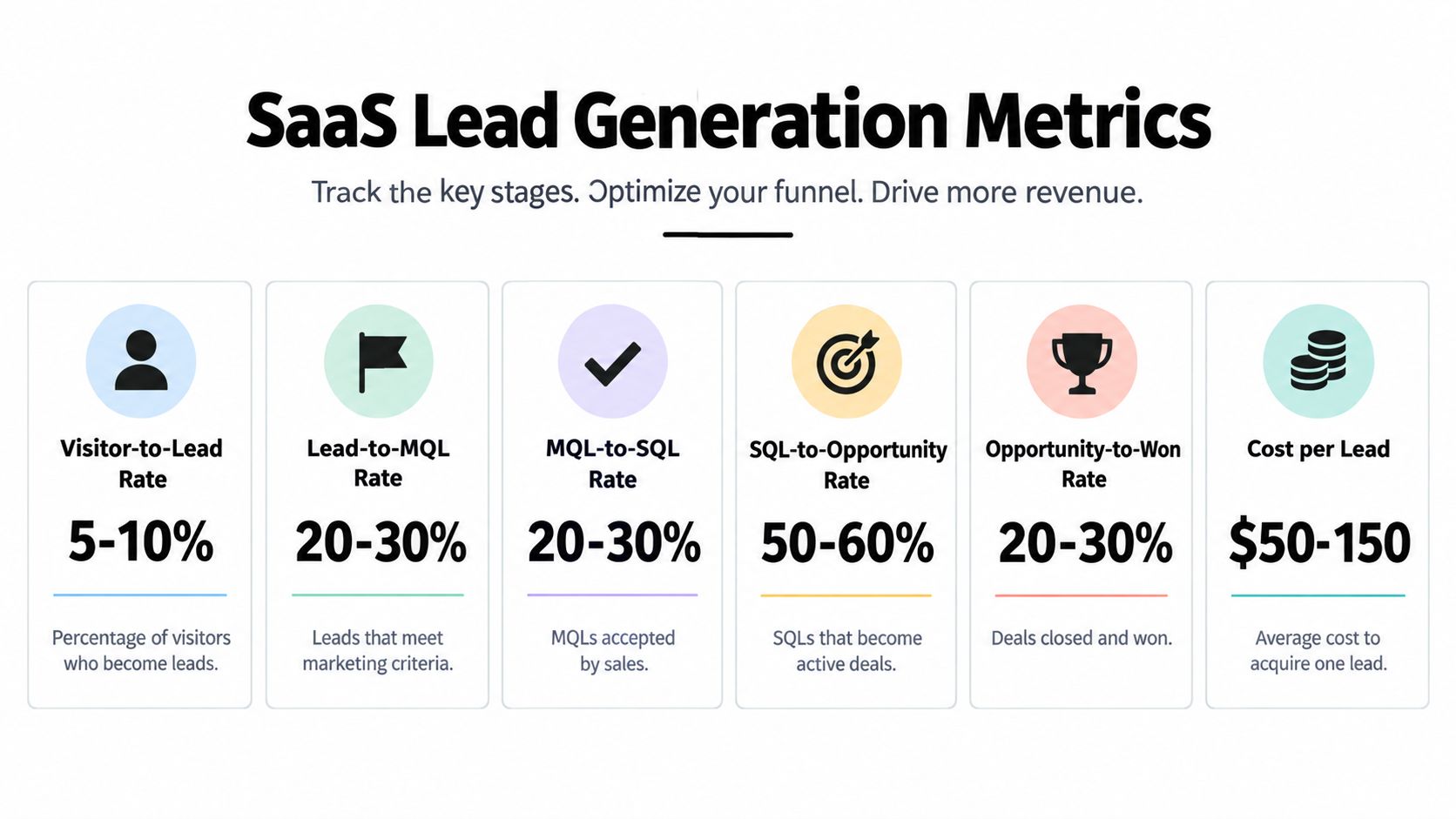
The benchmark summary from Digital Applied is useful here because it gives a full stage view, not just top-of-funnel activity. It reports median conversion rates of 2.8% visitor-to-lead, 34% lead-to-MQL, 19% MQL-to-SQL, 61% SQL-to-opportunity, and 24% opportunity-to-closed-won.
Those numbers help you ask better questions:
- Low visitor-to-lead rate: Is the traffic wrong, the offer weak, or the page too vague?
- Low lead-to-MQL rate: Are forms attracting low-fit people?
- Low MQL-to-SQL rate: Are scoring rules inflated, or is sales rejecting what marketing sends?
- Low SQL-to-opportunity rate: Are reps reaching the wrong buyers or entering too early?
- Low opportunity-to-won rate: Is the issue pricing, positioning, competition, or onboarding confidence?
Add cost and payback, not just conversion
Conversion alone can still fool you. A channel may convert well but cost too much for your sales cycle and contract size.
That's why cost per lead and CAC payback belong on the same dashboard. The channel cost benchmarks already covered earlier help with CPL. For payback discipline, the benchmark cited by The Insight Collective reported a 17-month median SaaS CAC payback period. If your funnel quality is weak, that payback stretches further.
Don't forget speed and scoring quality
Two more operational metrics matter a lot:
- Response speed: Fast follow-up often determines whether good intent becomes an actual conversation.
- Scoring accuracy: If high-scoring leads rarely convert, your model is rewarding the wrong behaviors.
Operating principle: A healthy lead gen engine creates alignment between source, intent, qualification, and follow-up. If one breaks, the later numbers absorb the damage.
What a founder dashboard should include
Keep it tight:
| Metric | What it tells you |
|---|---|
| Visitor-to-lead rate | Whether your site captures demand |
| Lead-to-MQL rate | Whether incoming leads fit your target |
| MQL-to-SQL rate | Whether marketing and sales agree on quality |
| SQL-to-opportunity rate | Whether outreach and discovery are working |
| Opportunity-to-won rate | Whether pipeline converts into revenue |
| Cost per lead by channel | Whether acquisition is efficient enough |
| CAC payback | Whether the whole motion is economically sustainable |
| Response time | Whether your team acts while intent is still fresh |
If you can see those clearly, you can usually find the bottleneck quickly.
Your Next Moves for Predictable SaaS Growth
If you're a small team, don't try to run every channel and every tactic at once. That's how lead gen becomes busy work.
Start by fixing the system in order. Define your stages clearly. Pick one or two high-intent channels. Build one focused offer for each major buyer problem. Make sure follow-up is fast. Then review stage conversion every week until you know exactly where leads stall.
A practical 30-day approach
In the next month, I'd prioritize this:
- Audit your funnel definitions so lead, MQL, SQL, and opportunity mean something operational.
- Choose one demand-capture channel and one conversation-driven channel instead of spreading budget thin.
- Rewrite one key landing page around a specific problem, not a broad product pitch.
- Tighten routing and response so serious leads don't wait.
- Track stage-by-stage movement instead of celebrating raw lead counts.
Cold outbound still has a place, but it shouldn't be your only growth bet when reply rates are falling and buyer attention is shifting toward higher-intent environments. The founders who build predictable pipeline are the ones who treat SaaS lead generation like a measured system, not a volume contest.
Focus on fewer touchpoints with stronger intent. Then improve how leads move, one stage at a time.
Bazzly helps SaaS founders and small teams turn Reddit conversations into a lead source by monitoring high-intent threads, surfacing relevant opportunities, and helping you respond with context instead of cold outreach. If you want a hands-off way to connect Reddit and AI-era discovery to a more predictable pipeline, take a look at Bazzly.


