10 Word of Mouth Marketing Tools for Growth
Most advice about word of mouth marketing tools starts with the wrong premise: that every referral product solves the same problem. It doesn't. A Reddit demand-capture platform, a Shopify referral app, a B2B advocacy hub, and a local review inbox all create recommendations differently, with different workloads, attribution limits, and governance risks.
The right choice depends on where advocacy already happens, whether you need automated demand capture or customer-led referrals, how much you need to connect a recommendation to revenue, and whether your team can manage an always-on program after launch. Word of mouth has never been limited to referral links. It has also included personal conversations, community participation, reviews, partner recommendations, and offline prompts. These word of mouth marketing examples make the operating differences clear.
This list organizes the strongest options by growth motion, from Reddit conversations and quick referral launches to enterprise advocacy, local reviews, and offline recommendations. Pricing signals use only the supplied product information. Before buying, check the current commercial terms directly with each vendor.
Table of Contents
- 1. Bazzly
- 2. ReferralCandy
- 3. Referral Rock
- 4. Friendbuy
- 5. Talkable
- 6. Extole
- 7. Mention Me
- 8. Viral Loops
- 9. Influitive
- 10. Birdeye
- Top 10 Word-of-Mouth Marketing Tools Comparison
- Choose the Growth Motion You Can Sustain
1. Bazzly
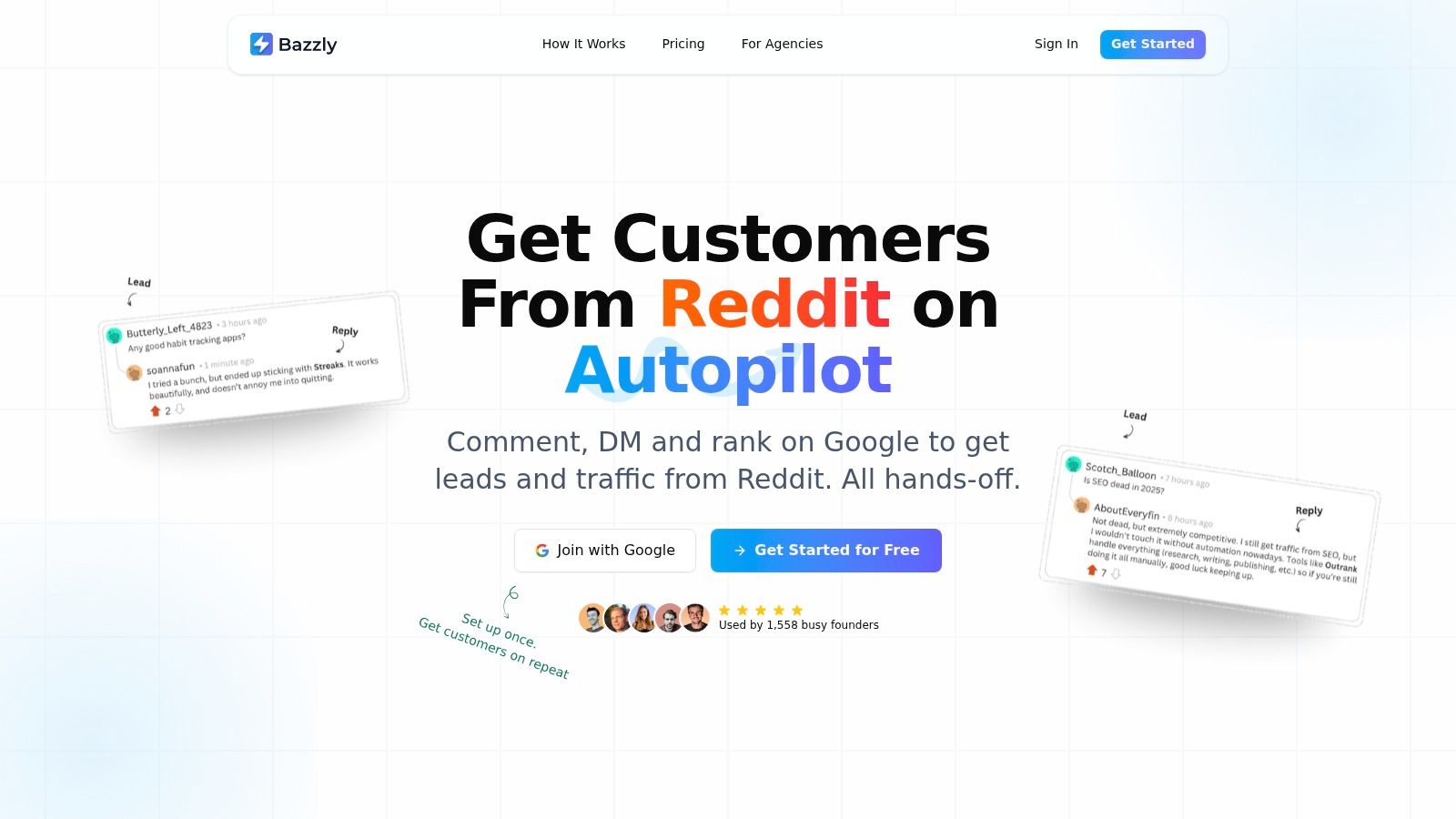
Bazzly is the strongest fit when your acquisition opportunity sits inside high-intent Reddit conversations, but your team doesn't have time to monitor subreddits all day. After setup, the platform scans relevant discussions, identifies threads where a product can be useful, drafts context-aware replies with AI, and can publish through warmed-up, aged accounts. You can also use a Chrome extension to post from your own account when brand control matters more than full automation.
That makes Bazzly different from a conventional referral platform. It doesn't wait for an existing customer to share a link. It finds people already describing a problem and puts a relevant recommendation into the conversation. One-click personalized DMs add a second conversion path for promising prospects.
Where Bazzly compounds
Reddit threads can continue attracting attention after the original discussion ends. Top-ranking threads may also appear in Google results and AI assistant answers, so a useful placement can create visibility beyond Reddit itself. That creates a compounding opportunity, but only when the reply is genuinely relevant and the account activity looks credible.
Bazzly supports full autopilot or manual approval, adjustable tone and targeting, AI drafting, direct support, rapid onboarding, and credit-based usage. The supplied product information lists a $99 monthly price, while the public site currently advertises an all-in-one plan at $199 per month with 170 credits. A comment through a warmed-up account uses 10 credits, an upvote uses 0.2 credits, and an AI draft or DM uses 0.1 credits. Confirm the current plan before budgeting.
Practical rule: Use automation to find and prioritize conversations, not to excuse irrelevant replies. Monitor subreddit fit, brand voice, and account activity continuously.
The trade-off is clear. Bazzly reduces the time sink and aims to minimize ban risk, but automated posting can still feel impersonal if targeting is loose. Founders, indie hackers, small B2B teams, and agencies should start with strict filters, review early replies, and measure qualified conversations rather than raw comment volume. See Bazzly for the current plan and onboarding details.
2. ReferralCandy
ReferralCandy is built for the fastest path from happy ecommerce customer to trackable referral. It supports two-sided incentives such as cash, store credit, gift cards, and free products, then handles tracking, verification, and payouts. Shopify merchants can launch quickly, while WooCommerce, BigCommerce, and custom stacks have integration and API options.
The product is particularly practical when your store already has a clean post-purchase journey. You can invite customers after delivery, provide a referral link or coupon code, and let the platform attribute the resulting order. Klaviyo and Tremendous integrations help connect the program to lifecycle messaging and reward fulfillment.
The commercial trade-off
ReferralCandy uses a success-fee model tied to net-new customers, with the fee applying to the first three orders. That can make the initial launch easy to justify because costs follow referred revenue. It can also become uncomfortable at higher referred volume, where a flat-fee platform may offer more predictable economics.
Ecommerce teams should compare the fee against gross margin, incentive cost, fraud losses, and the labor required to manage another system. The platform offers all features on every plan and supports unlimited campaigns, which reduces feature-gating friction.
For a deeper operating view, this guide to customer referral programs is useful when deciding where the referral prompt belongs in the customer lifecycle. ReferralCandy isn't the natural choice for a complex B2B SaaS motion without custom implementation, but it's hard to beat for a focused store launch. Visit ReferralCandy to verify current fees and integrations.
3. Referral Rock
Referral Rock fits teams that need a durable referral operating system, not just a post-purchase widget. It supports customer referrals, ambassador programs, and partner or affiliate programs through hosted member and recruiter portals. Participants can share links, codes, and QR codes, while the platform manages email invitations and reminders.
That breadth matters for B2B SaaS, services, consumer apps, and ecommerce businesses where different advocates need different program paths. A customer might refer a peer, a consultant might bring several clients, and a partner might need a separate commission structure. Keeping those motions in one system can simplify reporting and administration.
Why the operating model matters
Referral Rock includes a dedicated program advisor on every plan. That service layer is valuable for a founder who understands the commercial opportunity but doesn't want to design every invitation, reward, portal, and integration alone. Deep connections with CRM, billing, and ecommerce systems also make it better suited to ongoing programs than a one-off campaign tool.
The main constraint is capacity and complexity. The operator plan caps base members, and imports or add-ons can increase cost. A solo founder with one product and one reward may find the platform heavier than necessary. A growing company with multiple advocate types may see that same structure as a benefit.
Use Referral Rock when you want unlimited-referral economics, advisor-led setup, and a system that can expand into partner operations. Don't buy it merely because your first referral page needs to go live quickly. Evaluate the member model, data sync, and future program structure at Referral Rock.
4. Friendbuy
Friendbuy is aimed at companies treating referrals as a scaled, measurable acquisition channel. It supports referral placements across websites, apps, post-purchase flows, and offline experiences. Its attribution capabilities address the messy parts of real customer journeys, including multi-device behavior and hold or release rules for rewards.
This is the kind of tool to consider when finance, security, and growth teams all need confidence in the same program. Advocate Intelligence helps identify customer cohorts likely to share, while A/B testing and analytics support a more disciplined optimization process than merely changing reward copy and hoping conversion improves.
Precision costs implementation time
Friendbuy uses a flat annual license rather than CPA or revenue-share pricing. At scale, that can protect unit economics because the platform cost doesn't rise directly with referred revenue. Enterprise security and compliance, including SOC 2 Type II and ISO 27001 listed in the supplied product information, can also simplify reviews with larger organizations.
The trade-off is implementation weight. Pricing isn't public, and the platform typically requires a demo and an implementation window. Teams without a clear event model, reward policy, and analytics owner may spend more time preparing than operating.
Friendbuy is best for a brand with substantial referral volume, complex customer journeys, and a need to defend attribution decisions. It isn't the first tool I'd choose for validating whether customers will share at all. Start with the customer events and fraud rules you need, then assess Friendbuy against that specification.
5. Talkable
Talkable works well for mid-market and enterprise ecommerce teams that want referral performance plus ongoing optimization support. Its Liquid campaign editor lets teams configure campaigns and run A/B tests, while fraud controls protect reward economics. The platform also extends beyond basic referral links into loyalty, video referrals, and Apple or Google Wallet passes.
The useful distinction is its managed operating model. Talkable provides a reporting suite and a defined optimization cadence, which can range from monthly to weekly depending on the tier. That structure helps teams avoid the common failure mode where a referral program launches, performs acceptably, and then receives no attention for months.
A better fit for mature ecommerce
Talkable uses a flat monthly fee rather than CPA or revenue-share pricing. That aligns the vendor's commercial model with improving the program rather than collecting more money every time referred revenue grows. It can make planning easier for a high-volume store, although the fixed commitment only works if the team is ready to use the service.
The supplied plan notes mention typical 12-month agreements and an implementation fee commonly equal to one month of plan price. Pricing should be confirmed directly, because contract terms and packaging can change. B2B teams will likely need custom work, so the platform makes more sense for ecommerce brands with established lifecycle and merchandising operations.
Choose Talkable when managed services, testing discipline, and flat-fee economics matter more than a lightweight launch. If you only need one simple “give and get” campaign, its service layer may be more than you need.
6. Extole
Extole is designed for complex customer-led growth programs that combine referral, loyalty, incentives, and personalization. It can manage offers across multiple programs, automate rewards, apply fraud controls, and connect performance data to a larger marketing stack. Integrations with marketing partners, including SMS tools such as Attentive, support coordinated customer journeys.
The platform is strongest when referral isn't an isolated growth experiment. A large catalog, multiple customer segments, several reward types, and several communication channels create operational problems that simpler tools don't always handle cleanly. Extole's orchestration approach is built for that environment.
Don't confuse breadth with speed
The same enterprise depth creates the central trade-off. Pricing isn't public and generally requires an enterprise-level budget. A small team seeking a basic referral flow could spend more time configuring governance, integrations, and offer logic than generating useful learning.
Extole also makes more sense when a dedicated owner can manage incentives, reporting, fraud review, and lifecycle coordination. Without that owner, additional functionality becomes shelfware. Before requesting a proposal, document your program architecture, catalog structure, reward rules, and required integrations.
For large organizations that need one platform across interconnected advocacy motions, Extole deserves a serious evaluation. For an early-stage product, start smaller and earn the complexity through proven demand.
7. Mention Me
Mention Me is built around a problem that link-based referral programs often miss: people recommend products in conversation, without opening a tracked referral URL. Its Name Share capability helps capture and attribute those offline or real-world referrals, while Behavioral AI identifies customers more likely to advocate.
That approach suits brands focused on earned growth and customer lifetime value rather than blanket incentives. Instead of showing the same offer to every customer, the team can segment advocates and test which experiences prompt the right people to share. The platform's optimization engine is described as being trained on a network of more than 45,000 tests. That figure comes from the supplied product information and should be validated with the vendor during evaluation.
A structured testing commitment
Mention Me is not a casual Shopify add-on. Custom pricing, segmentation, privacy-safe data use, and a heavier implementation make it more appropriate for teams prepared to run structured tests and analyze customer behavior.
The value proposition is strongest when many recommendations happen away from the click path. A customer may tell a friend a brand name, and the friend may later arrive through a direct visit or a search. Capturing that influence can produce a more complete picture than relying only on referral codes.
Consider Mention Me when offline word of mouth is commercially important and your team can support experimentation. If your immediate need is a simple share button, its predictive and attribution capabilities may be unnecessary.
8. Viral Loops
Viral Loops is the practical choice for teams that need to launch a referral, waitlist, giveaway, or newsletter-growth campaign quickly. Its templates reduce the design and engineering work involved in building a participant flow, while custom domains, an API, and webhooks provide an upgrade path when the campaign becomes more important.
Early-stage SaaS companies, indie hackers, and agencies can use the platform to test whether a milestone program or prelaunch loop creates meaningful participation. Unlimited campaigns on most tiers are useful when a team wants to run separate experiments rather than force every audience into one permanent program.
Fast launch, finite capacity
The platform offers a 14-day trial, but participant caps vary by plan. That matters if a campaign suddenly gains traction or an agency needs to support multiple client audiences. Advanced automation may also require developer help, even when the initial campaign uses a no-code template.
The right way to use Viral Loops is as a focused experiment with a defined participant action and conversion event. Don't treat a giveaway entry as proof of customer advocacy. Measure whether participants invite relevant people, whether those invitees activate, and whether the loop creates customers or only more entries.
Teams researching adjacent tools can also review these growth hacker tools before deciding whether a referral loop is the right motion. Test the simplest useful campaign first, then explore Viral Loops for API and managed-service requirements.
9. Influitive
Influitive is for B2B teams that want to mobilize customers for more than referrals. Its advocacy hub supports gamification, rewards, targeting, and templates for activities such as references, reviews, and content participation. Community features add discussions, ideation, and a knowledge base, giving advocates reasons to return even when they aren't actively sharing a link.
That makes it a better fit for a customer advocacy program than a narrow referral campaign. A SaaS company can invite a customer to review a product, join a reference call, contribute feedback, share content, or refer a peer. The same relationship can support pipeline and retention when the team manages it thoughtfully.
Advocacy needs an operator
Influitive's flexibility is also its warning label. Custom pricing is typically higher than lightweight referral applications, and engagement won't sustain itself without active program management. Someone must plan activities, segment invitations, recognize participation, and connect advocacy actions to commercial outcomes.
The platform's analytics and ROI reporting help with that accountability, while reference and review workflows make the program easier to connect to revenue operations. Still, a large activity catalog can overwhelm advocates if the team sends every request to everyone.
Choose Influitive when customer advocacy is a strategic function with a clear owner. If you only need to ask satisfied customers for one referral after purchase, use a simpler tool.
10. Birdeye
Birdeye fits multi-location and local businesses where word of mouth depends on reviews, messaging, and timely follow-up. It brings SMS, webchat, social messaging, surveys, review generation, review monitoring, responses, and referral requests into one operational inbox.
That combination matters because local recommendations rarely follow a neat referral-program path. A customer may receive a text after a visit, leave a review, ask a question, and later refer someone through another conversation. Birdeye lets the business keep those interactions connected instead of splitting them across review software, a messaging tool, and a separate referral system.
Local reputation is an operating process
The platform supports referral requests through text and email, contact management, tracking, and a broad integration ecosystem. The supplied product information lists more than 3,000 integrations and experience scoring. Treat those capabilities as infrastructure, not as a substitute for a strong service experience.
Pricing isn't transparent and is commonly perceived as premium. Birdeye is therefore more appropriate for multi-location operators with enough customer interaction volume to justify a unified system. A SaaS startup with no local review motion will probably pay for capabilities it won't use.
Before evaluating the platform, define who owns review responses, escalation, SMS consent, and referral follow-up. This reputation management guide can help frame the broader workflow. Then compare the current package at Birdeye with the cost of keeping messaging and reviews separate.
Top 10 Word-of-Mouth Marketing Tools Comparison
| Product | Core features ✨ | UX / Quality ★ | Price & Value 💰 | Target 👥 | USP 🏆 |
|---|---|---|---|---|---|
| Bazzly 🏆 | 24/7 subreddit monitoring, AI drafts, warmed accounts, smart upvotes, 1‑click DMs | Hands-off autopilot, rapid onboarding, direct support ★★★★☆ | All‑in‑one plan $99–$199/mo; credit‑based (scaling cost) 💰 | Founders, indie hackers, small B2B teams, agencies 👥 | Predictable Reddit growth + Google/AI amplification; minimized ban risk 🏆 |
| ReferralCandy | Two‑sided incentives, automated payouts, Shopify/Woo integrations | Very fast deploy, sensible defaults ★★★★ | % success‑fee model tied to referred sales 💰 | Ecommerce founders (Shopify, WooCommerce) 👥 | Quick, low‑lift referral launches ✨ |
| Referral Rock | Hosted portals, CRM & billing integrations, email invites | Advisor‑led setup, flat pricing for volume ★★★★ | Flat pricing; advisor included (scales with add‑ons) 💰 | B2B SaaS, services, teams wanting hands‑off programs 👥 | Advisor‑led launches + unlimited referrals ✨ |
| Friendbuy | Onsite/in‑app placements, advanced attribution, security (SOC2) | Enterprise polish, demo & implementation required ★★★★★ | Flat annual license; custom pricing (no CPA) 💰 | Enterprise brands needing security & scale 👥 | Enterprise security + precise attribution ✨ |
| Talkable | Liquid editor, A/B testing, fraud controls, managed services | Managed optimization cadence, ecommerce focus ★★★★ | Flat monthly fee; typical 12‑mo agreements & setup fee 💰 | Mid‑market / enterprise ecommerce teams 👥 | Managed services + no revenue share ✨ |
| Extole | Offer mgmt, automated rewards, fraud controls, analytics | Built for complex, multi‑touch programs ★★★★ | Custom enterprise pricing; premium budgets 💰 | Large enterprises with complex catalogs 👥 | Orchestration across channels & personalization ✨ |
| Mention Me | NameShare tracking, Behavioral AI, optimization library | Data‑driven optimization; proven LTV uplifts ★★★★ | Custom pricing; test/optimize approach 💰 | Brands focused on earned growth & LTV 👥 | Predictive referrer ID & large test library ✨ |
| Viral Loops | Templates (milestone, waitlist, referral), API, webhooks | Fast no‑code launches; trial available ★★★★ | Tiered plans, participant caps on plans; trial 💰 | Early‑stage SaaS, indie hackers, agencies 👥 | No‑code viral/referral templates for quick launches ✨ |
| Influitive | Advocacy hub, gamification, community + analytics | Purpose‑built for B2B advocacy; active management needed ★★★★ | Custom pricing; typically higher 💰 | B2B SaaS teams building advocate communities 👥 | Mobilizes advocates for referrals, references, reviews ✨ |
| Birdeye | Reviews, centralized messaging (SMS/webchat), referrals | Unified inbox for CX, strong SMS tooling ★★★★ | Premium/custom pricing; perceived as high cost 💰 | Multi‑location & local businesses (retail, service) 👥 | All‑in‑one local experience+SMS outreach for reviews/referrals ✨ |
Choose the Growth Motion You Can Sustain
The best tool isn't the one with the longest feature list. It's the one that matches where customers already talk, gives you enough attribution to make decisions, and fits the amount of program management your team can sustain.
Choose Bazzly when your opportunity is high-intent Reddit demand and you need automation rather than another manual monitoring task. Its value comes from finding relevant conversations, drafting context-aware replies, supporting account or autopilot workflows, and creating a path from public discussion to qualified DM. Keep human review involved early, especially where subreddit norms and brand credibility are sensitive.
Choose ReferralCandy or Viral Loops for a fast, focused launch. ReferralCandy is the natural ecommerce option when you need incentives, post-purchase invitations, and automated tracking. Viral Loops is better when you're testing waitlists, milestones, giveaways, or newsletter growth and want templates with an API path later.
Referral Rock is the stronger choice for broader referral and partner operations. Mention Me makes more sense when offline recommendations and predictive advocate selection matter. Influitive is the better B2B option when customers can contribute references, reviews, content, feedback, and referrals inside one advocacy community. Birdeye belongs with local and multi-location businesses where review requests, SMS conversations, and referrals share the same operational workflow.
For larger, more complex programs, evaluate Friendbuy, Talkable, or Extole. Friendbuy emphasizes precise attribution, fraud controls, security, and flat annual licensing. Talkable adds managed optimization for mature ecommerce programs. Extole is suited to organizations coordinating referral, loyalty, personalization, rewards, and marketing integrations across a complex stack.
Before committing, validate six things:
- Audience fit: Confirm that the tool reaches the channel where recommendations happen.
- Attribution depth: Test links, codes, multi-device journeys, direct visits, offline name sharing, and delayed conversions.
- Reward economics: Model incentives, fees, fraud, refunds, gross margin, and reward release rules.
- Implementation workload: Identify integrations, data owners, engineering needs, review processes, and launch support.
- Pricing model: Compare success fees, revenue share, flat licenses, implementation fees, member caps, participant caps, and contract terms.
- Governance: Define brand voice, consent, fraud detection, account safety, community rules, escalation, and reporting ownership.
Market context supports taking this category seriously. The customer advocacy software market was valued at $2.81 billion in 2025 and is projected to reach $8.0 billion by 2035, with an estimated 11.0% CAGR, according to Wise Guy Reports. G2 lists 174 customer advocacy software products with an average rating of 4.52 out of 5, while referral software has 4,234 reviews and a 4.7 out of 5 average rating, as shown in G2's customer advocacy category. Those figures show a crowded, established market, not proof that every program will work for your audience.
Start with one measurable motion. Pick one audience, one trigger, one advocate action, one reward or recognition model, and one conversion event. Run the program long enough to learn whether the recommendations are qualified and incremental, then add complexity only when the operating evidence justifies it.
Bazzly helps founders and small teams turn Reddit conversations into repeatable customer acquisition through 24/7 opportunity discovery, AI-drafted replies, account or autopilot posting, and personalized DMs. If Reddit is where prospects already ask for solutions, visit Bazzly to see whether its credit-based workflow fits your next word of mouth marketing program.
