Is Lead Generation Worth It? the Founder's ROI Guide
Lead generation is worth it only when customer lifetime value exceeds cost per qualified lead by at least 3:1. Organic-search leads close at approximately 14.6%, compared with about 1.7% for outbound leads, but even strong intent won't rescue a campaign that produces unqualified contacts or weak follow-up.
The popular advice is simple: generate more leads. A founder adds another campaign, another list, another automation tool, then watches the CRM fill with names that never become opportunities. That isn't growth. It's inventory.
The finance question is narrower and more useful: does one additional qualified lead create more gross profit than the channel consumes? The answer depends on customer lifetime value, qualification, sales capacity, payback period, and attribution. Lead generation is a lever, not a business model. Pull it only when the economics support the motion.
Table of Contents
- The Core Question Behind Lead Generation ROI
- Why Organic Intent Outperforms Cold Outreach
- Channel Economics and Reddit Automation Versus Paid Ads
- The Hidden Trap and Why 79% of Leads Fail
- How to Calculate Your Break-Even Point
- When to Stop and When to Scale
The Core Question Behind Lead Generation ROI
Asking whether lead generation is worth it is too blunt to guide a budget decision. The useful question is narrower: under your sales process, does an additional qualified lead produce more gross profit than it consumes in acquisition and follow-up cost? Two companies can run the same channel and get opposite outcomes because lifetime value, retention, deal size, qualification standards, and sales capacity are different.
That framing matters more for small B2B teams than lead volume does. A company with strong retention and healthy margins can tolerate a higher acquisition cost. A company with a lower-priced offer or weak activation can lose money even when top-of-funnel reporting looks healthy.
The comparison should be expected gross profit per qualified lead versus total cost per qualified lead. Total cost means more than ad spend or software fees. It also includes campaign labor, sales time, qualification work, onboarding effort, and the cost of contacts that never become opportunities. Customer lifetime value should be measured as gross profit, not revenue, because revenue alone does not fund payroll or recover acquisition spend.

A pipeline full of weak-fit names can be more expensive than a short list of buyers with clear intent. A campaign that produces 1,000 low-fit contacts may absorb more founder attention, sales effort, and qualification time than one that creates 10 high-intent conversations. The second campaign can still win economically if those conversations are closer to purchase and better aligned with the product.
Volume hides the true cost
Lead counts become misleading when the team defines success before it defines qualification. Someone who downloaded a resource, replied once, or joined a list has not yet created economic value. The business still needs to confirm fit, identify the buyer, validate intent, and move that account through a buying process that may require significant labor.
That is why channel evaluation needs stricter accounting:
- Reach is not pipeline. Exposure metrics show attention, not profit.
- A lead is not a customer. A channel earns credit when qualified demand moves toward profitable revenue.
- Cheap is not always efficient. A low-cost contact can become expensive after follow-up and sales labor are included.
- Small samples still need discipline. One closed deal can justify a channel only when gross profit exceeds full channel cost.
Campaign design should reflect the economic outcome it is supposed to create. AdCrunch explains campaign objectives in a way that helps separate awareness, engagement, and conversion goals. That distinction matters because an awareness campaign should not be judged by the same standard as a program built to create qualified opportunities.
CFO rule: Never approve a lead target without approving the conversion definition and the maximum acceptable acquisition cost.
The 3:1 lifetime-value-to-qualified-lead-cost ratio is a practical margin of safety for small B2B teams. It leaves room for forecasting error, delayed conversion, churn, and labor that rarely appears in channel reporting. It is not universal. It is a break-even buffer. Below that line, ordinary execution problems can erase the return.
Why Organic Intent Outperforms Cold Outreach
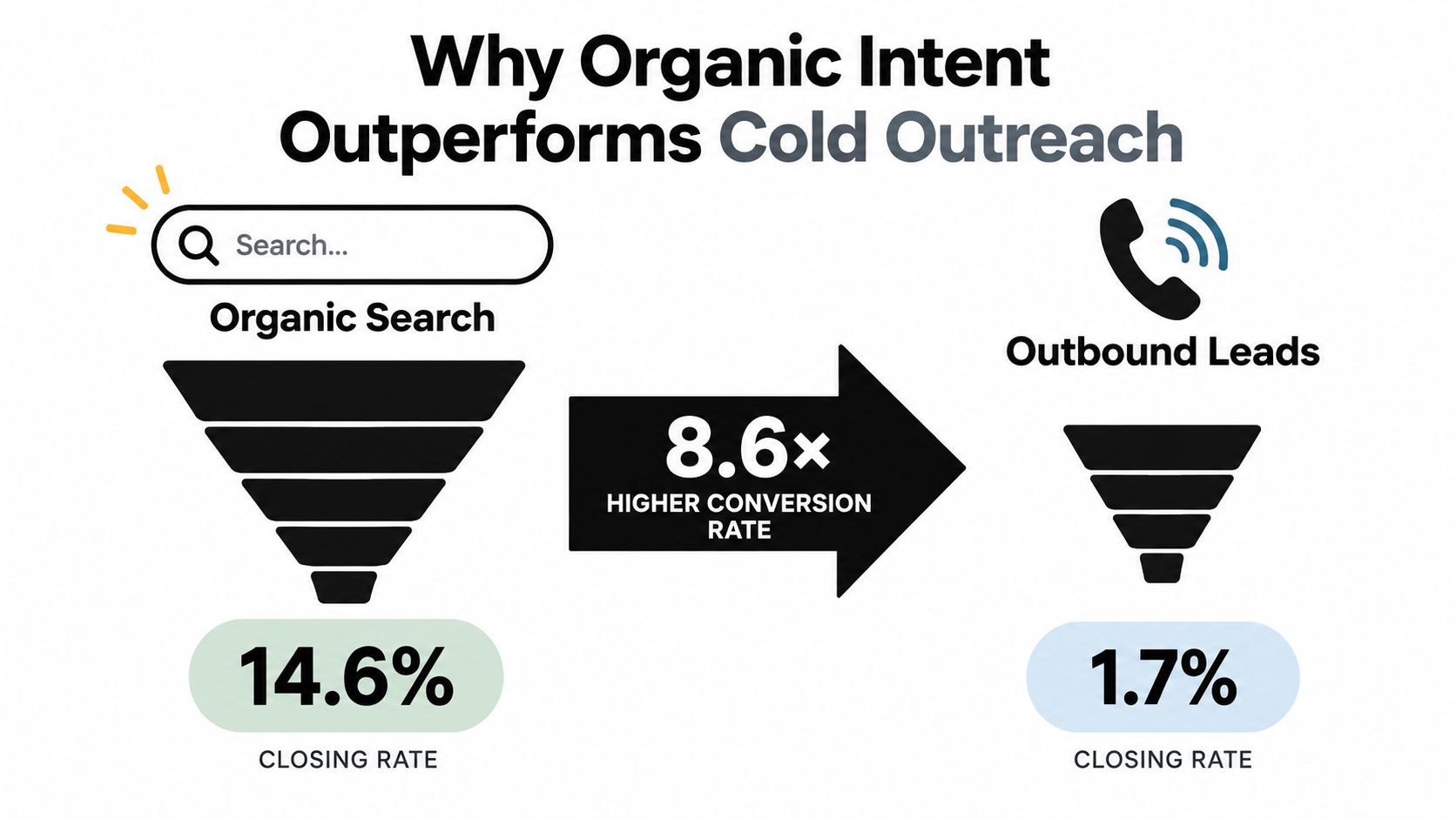
Cold outreach is often judged on volume because volume appears fast. For a small B2B team, that framing hides the true constraint. Sales time is limited, and the channel that consumes fewer touches per closed customer usually has better economics.
Organic search tends to start later in the buying process. The prospect has already defined a problem, chosen a category, and begun comparing options. Outbound outreach reaches people earlier, when the seller may still need to establish that the problem matters, that the category is relevant, and that a conversation is worth scheduling.
The practical implication is not that organic is always better. It is that intent changes the denominator. If 100 leads arrive through search and another 100 arrive through outbound, equal lead counts do not imply equal revenue potential. At the close-rate gap shown above, the search cohort can produce far more customers from the same top-line lead total. It can also spare the team dozens of low-yield follow-ups, because fewer conversations are spent educating people with weak immediate need.
That distinction matters more when headcount is tight. A founder-led sales motion often breaks not because lead flow is too low, but because too much effort is spent qualifying poor-fit interest. In that situation, intent capture is not a branding preference. It is a capacity decision. Learn how to capture this intent with a system for how to get inbound leads.
Organic traffic still has acquisition cost. Content strategy, subject-matter expertise, editing, technical SEO, and distribution all consume money or labor. Search is not free because clicks do not carry a visible media fee. The right comparison is broader: what does it cost to create one qualified conversation, and how much selling work is required before that conversation becomes revenue?
Why the denominator matters
Many channel reports fail at this point. They compare lead totals while ignoring the labor between lead and customer. A broad outbound campaign can generate activity and still perform poorly once qualification calls, reminders, demos, and objection handling are added to the cost base.
Search can fail too. A page may rank and still pull in the wrong audience. Some visitors want definitions, some want free tools, and some have a use case the product cannot serve. Traffic without fit is only cheaper-looking waste.
The useful filter is alignment:
- Problem alignment: Does the query reflect a problem the product actually solves?
- Commercial proximity: Is the visitor evaluating options, or only learning the topic?
- Qualification path: Can the page move a good-fit visitor toward a meaningful next step?
- Measurement quality: Can the team connect the visit to pipeline and later revenue?
Founders can use proven B2B SEO strategies to build pages around commercial pain points rather than vanity traffic. They should also connect those pages to a clear qualification mechanism, such as a relevant demo, assessment, or sales conversation.
The key distinction is demand capture versus demand creation. Search usually captures demand that already exists. Outbound can create awareness where none exists yet. Both have a place. The financial test stays the same: does qualified demand generate more gross profit than the channel consumes?
Channel Economics and Reddit Automation Versus Paid Ads
Channel comparison becomes clearer when the company puts real costs beside realistic outcomes. Benchmark data places average Google Ads cost per lead at approximately $70.11, while average B2B cost per lead is near $198 to $200. Referrals reportedly average about $25 per B2B lead, according to paid lead-generation benchmarks from SHNO.
Those figures aren't interchangeable with qualified-lead cost. A paid form submission may need substantial filtering before it reaches sales. A referral may arrive with stronger trust and clearer context. The same stated cost per lead can therefore produce very different economics after conversion, labor, and retention are included.
Compare the spend with the product's gross profit
Consider a SaaS company evaluating a $99 monthly workflow. The investment is viable if the workflow produces at least one customer whose gross profit exceeds the monthly cost, assuming the customer is incremental and the measurement period is appropriate. The investment is not viable merely because it produces contacts at a lower nominal cost than paid advertising.
A simple comparison looks like this:
| Channel or approach | Stated benchmark or cost | Economic question |
|---|---|---|
| Google Ads | Approximately $70.11 per lead | How many leads become qualified opportunities and customers? |
| Average B2B acquisition | Approximately $198 to $200 per lead | Can customer gross profit support the acquisition cost and sales labor? |
| Referral acquisition | Approximately $25 per B2B lead | Does the lower cost reflect stronger fit and conversion? |
| Monthly workflow | $99 per month | Does one acquired customer's gross profit exceed the monthly spend? |
The product economics should determine which channel deserves attention. A low-priced subscription can't tolerate a long sequence of paid clicks, sales calls, and onboarding work unless retention supports the investment. A higher-value contract may justify a costly acquisition process, but only when the sales team can convert and retain the account.
Where Reddit fits
Reddit can sit between search and outbound because users often describe a live problem in their own words. That creates a useful context signal, but it doesn't guarantee permission to pitch. Relevant participation must answer the question, fit the conversation, and preserve credibility.
A founder considering a dedicated Reddit marketing tool should evaluate it against the same measures used for paid ads: qualified-lead rate, opportunity rate, customer conversion, gross profit, and follow-up time. The channel's apparent affordability is irrelevant if its contacts don't fit the product or if the founder can't respond to them.
The right comparison isn't “automation versus ads.” It's incremental gross profit versus fully loaded acquisition cost. Paid ads buy distribution. Community-led acquisition can expose demand in context. Neither earns a positive return without qualification and conversion.
The Hidden Trap and Why 79% of Leads Fail
Lead generation often takes the blame when the actual failure sits one step later, in qualification and follow-up. As noted earlier, 79% of marketing leads never become sales. For a small B2B team, that figure matters less as a headline than as a cost warning. If 100 leads enter the funnel and 79 stall before sales acceptance, the effective cost per accepted lead becomes far higher than the advertised cost per lead.
That changes the ROI test. A channel can look efficient at the top of the funnel and still destroy margin if the business cannot sort, route, and advance the contacts it creates. More spend only feeds the leak.
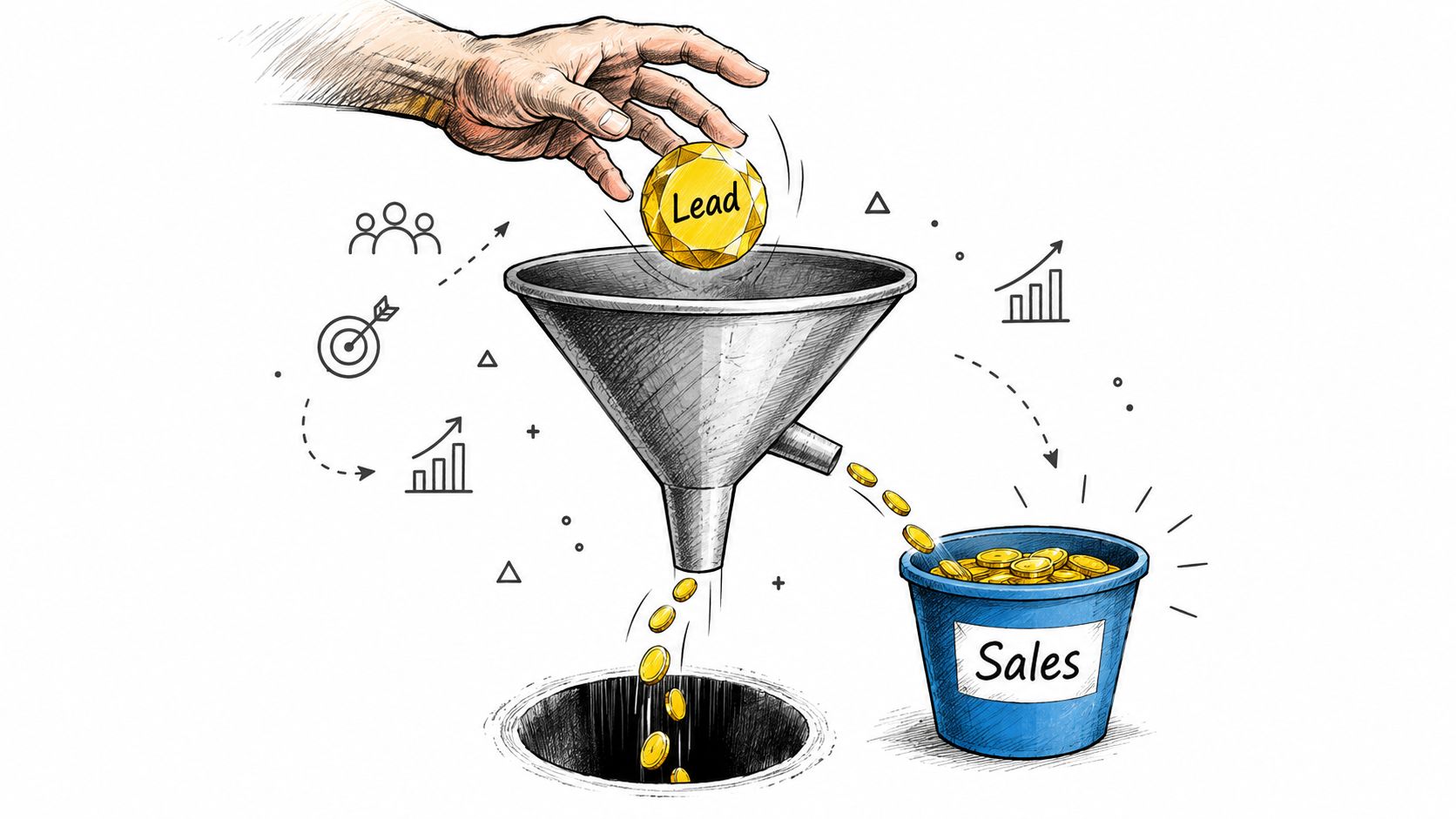
Treat the funnel as a leak test
Every stage should have a clear definition and a financial consequence:
- Captured: The company has a contact and a lawful reason to communicate.
- Qualified: The prospect matches the target profile and shows a relevant need.
- Accepted by sales: Someone owns the next action and its deadline.
- Opportunity: The prospect has a defined problem, buying context, and plausible path to purchase.
- Customer: The account generates revenue that can be compared with acquisition cost.
This structure helps separate channel failure from operating failure. When contacts die before qualification or sales acceptance, the problem is often weak targeting, slow response time, or vague ownership. When later-stage opportunities stall, the issue usually shifts to message quality, product fit, pricing, sales execution, or onboarding.
That distinction is expensive to ignore.
A simple nurture system does not need to be elaborate. It needs to respond quickly, reference the prospect's actual context, ask one useful qualification question, and offer a clear next step. Generic sequences sent to every contact may keep activity high, but they usually lower conversion quality because they ignore why the person engaged in the first place.
The video below can help teams think about the sales process as a connected system rather than a collection of isolated campaign metrics.
Automation doesn't replace judgment
Automation can find conversations, draft replies, and trigger reminders. It cannot determine whether a prospect has a live buying problem, whether outreach is appropriate in that moment, or whether the offer actually fits the account.
Email follow-up introduces another constraint. Teams running outbound sequences should understand SMTP warmup because deliverability affects whether messages are even seen. But inbox placement does not fix weak economics. A relevant offer sent to a qualified buyer can justify follow-up cost. An irrelevant message sent perfectly still wastes time and budget.
The unit-economics consequence is direct. When leads are acquired but not converted, the same acquisition spend is spread across fewer customers. Effective customer acquisition cost rises, payback lengthens, and a channel that looked affordable at the lead level can fail at the profit level. Lead generation is worth it only when the company can operate the conversion system behind it with enough discipline to turn contacts into customers.
How to Calculate Your Break-Even Point
Founders don't need a complex attribution platform to test lead-generation economics. They need a consistent definition of cost, a defensible conversion assumption, and a review window long enough to capture the relevant sales process.
Start with the fully loaded channel cost. Include software, media, content production, contractor time, founder time, sales labor, qualification, onboarding, and the cost of tools used to track and nurture prospects. Then estimate the gross profit created by an acquired customer, not just the first invoice.
Build the calculation in five steps
-
Calculate customer gross profit.
Use expected customer lifetime revenue multiplied by gross margin, then subtract variable onboarding and support costs. If the business doesn't yet have reliable retention data, use a conservative scenario rather than an optimistic lifetime assumption. -
Calculate expected profit per qualified lead.
Multiply customer gross profit by the qualified-lead-to-customer conversion rate. The result is the expected gross profit generated by one qualified lead before acquisition cost. -
Calculate total qualified-lead cost.
Divide complete channel cost by the number of qualified leads, not raw contacts. If qualification is informal, the company should label the result as provisional. -
Apply the safety threshold.
A channel passes the recommended test when customer lifetime value exceeds cost per qualified lead by at least 3:1. That cushion protects the plan from normal forecasting error and operational leakage. -
Run scenarios.
Model conservative, base, and strong outcomes. If the channel works only under the strongest assumption, it isn't ready to scale.
| Metric | Value | Notes |
|---|---|---|
| Monthly channel cost | Enter actual cost | Include tools, labor, media, and founder time |
| Qualified leads | Enter measured count | Exclude unverified contacts |
| Cost per qualified lead | Calculate | Monthly channel cost divided by qualified leads |
| Customer gross profit | Calculate | Lifetime gross profit less variable delivery costs |
| Qualified-lead-to-customer rate | Enter measured rate | Use a conservative estimate when data is limited |
| Expected gross profit per qualified lead | Calculate | Customer gross profit multiplied by conversion rate |
| LTV to qualified-lead-cost ratio | Calculate | Target at least 3:1 |
The break-even formula is straightforward:
Expected gross profit from acquired customers = qualified leads × lead-to-customer conversion rate × customer gross profit.
The channel is economically justified when that result exceeds total channel cost. Founders who want a broader view of the same discipline can use this SaaS marketing ROI framework to connect acquisition with recurring revenue, margin, and retention.
One warning matters more than the formula. Don't use a high lifetime-value estimate to justify a channel before the company has evidence that customers stay. Retention assumptions can turn a losing campaign into a spreadsheet winner.
When to Stop and When to Scale
Lead generation deserves more investment when four conditions appear together: the product solves a defined problem, qualified prospects respond, the sales team can follow up, and customer gross profit supports acquisition cost. If one of those conditions is missing, more lead volume may increase waste faster than revenue.
A small team should stop or pause a channel when:
- Qualification is unclear: The CRM contains contacts, but the team can't explain why they fit.
- Sales capacity is constrained: Founders can't respond promptly or provide the required demos and follow-up.
- Payback is too dependent on hope: The model requires unusually long retention or an unproven upsell path.
- Attribution is flattering the channel: The reported conversion may have happened through another route anyway.
- Higher-value work is neglected: Activation, retention, product quality, or referrals may produce better returns than additional acquisition.
Scale only after the company can identify the conditions behind successful conversions. That means recording the source, first touch, self-reported discovery path, qualified-lead status, time to opportunity, assisted interactions, customer conversion, and cohort retention.
Attribution deserves caution because B2B buying journeys are rarely linear. A 2025 benchmark reported an average journey of 211 days, 76 touches, 6.8 stakeholders, and 3.7 channels in research on B2B buying-journey complexity. A last-click report may award credit to the final demo request while ignoring the earlier conversation that created familiarity.
The channel that starts demand may not be the channel that closes the deal.
For small teams, a lightweight measurement system is often enough. Use tagged landing pages, first-touch records, self-reported attribution, qualified-lead rates, time to opportunity, assisted pipeline, and retention by acquisition cohort. For community-led acquisition, separately inspect direct clicks, branded searches, organic mentions, assisted conversions, and the quality of signups over a meaningful period.
The decision is therefore conditional, not binary. Scale when gross profit, qualified demand, and follow-up capacity reinforce one another. Stop when the channel creates activity without profitable customer value. A founder's scarce resource isn't just money. It's attention, and every low-quality lead consumes it.
Bazzly helps founders and small teams monitor Reddit conversations, identify high-intent threads, and draft context-aware replies or personalized direct messages through automated workflows. Visit Bazzly to evaluate whether Reddit demand capture can meet your qualified-lead economics before you commit more budget or founder time.


