Lead Generation Cost Per Lead: A Founder's Guide
You're looking at two campaign dashboards, and both claim to be right. Google Ads reports a $70 cost per lead. Your CRM shows that only a fraction of those contacts became qualified opportunities. Reddit appears to cost nothing, yet you've spent hours researching threads, writing replies, and following up with prospects.
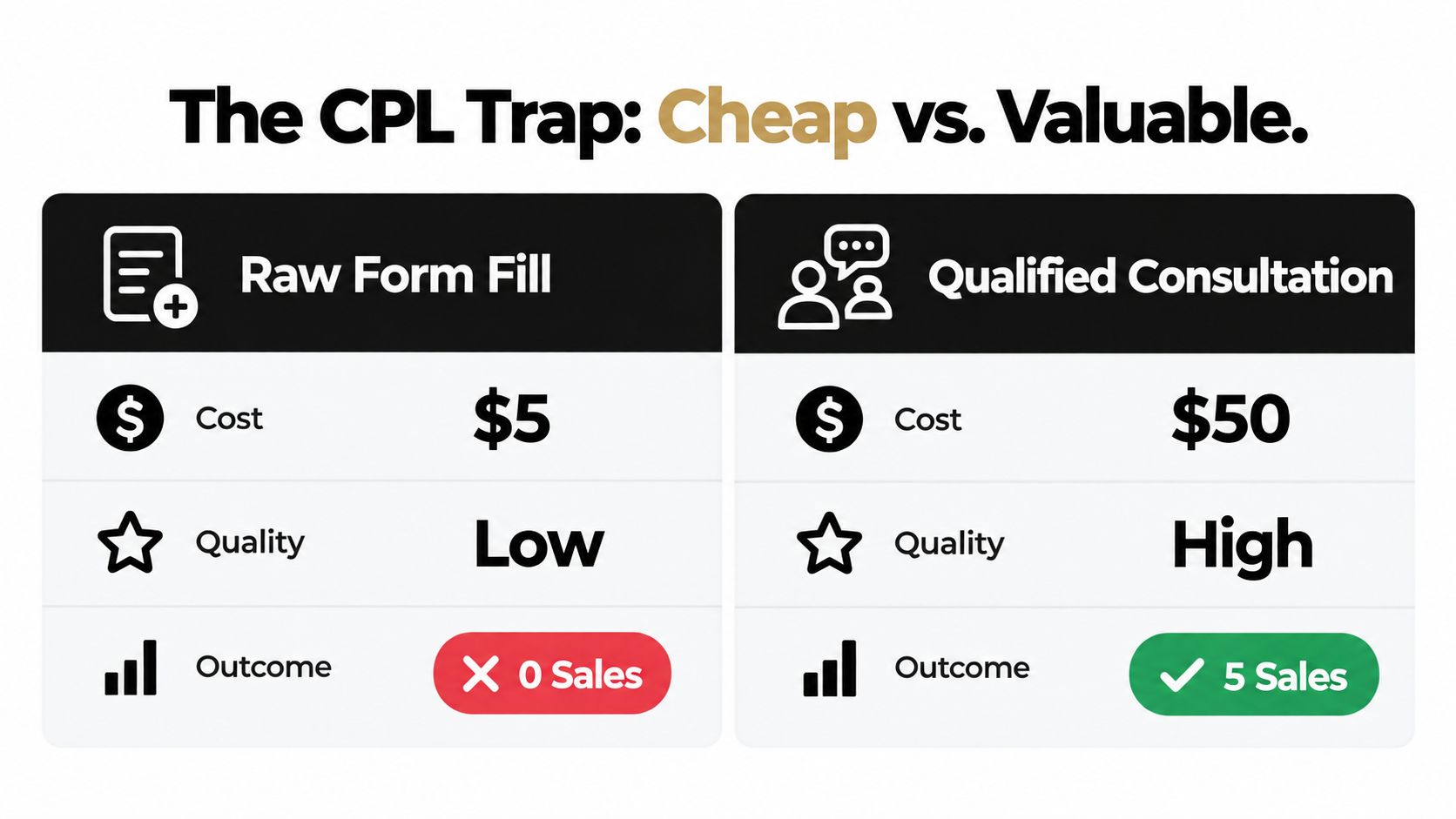
That's the problem with treating lead generation cost per lead as one universal number. CPL only means something when you define the lead, include the actual acquisition cost, and connect the result to revenue. A cheap form fill can be worse than an expensive conversation if the first produces no pipeline and the second produces customers.
Table of Contents
- What Lead Generation Cost Per Lead Really Means
- The CPL Formula and How to Use It
- Real CPL Benchmarks by Channel and Funnel Stage
- Why Raw CPL Can Lie to You
- What Actually Moves Your CPL Up or Down
- Strategies to Lower CPL Without Killing Lead Quality
- Building Your Own CPL Decision Framework
What Lead Generation Cost Per Lead Really Means
Cost per lead is a ratio:
CPL = acquisition cost ÷ number of leads
That formula looks simple. The difficult part is deciding what belongs on either side.
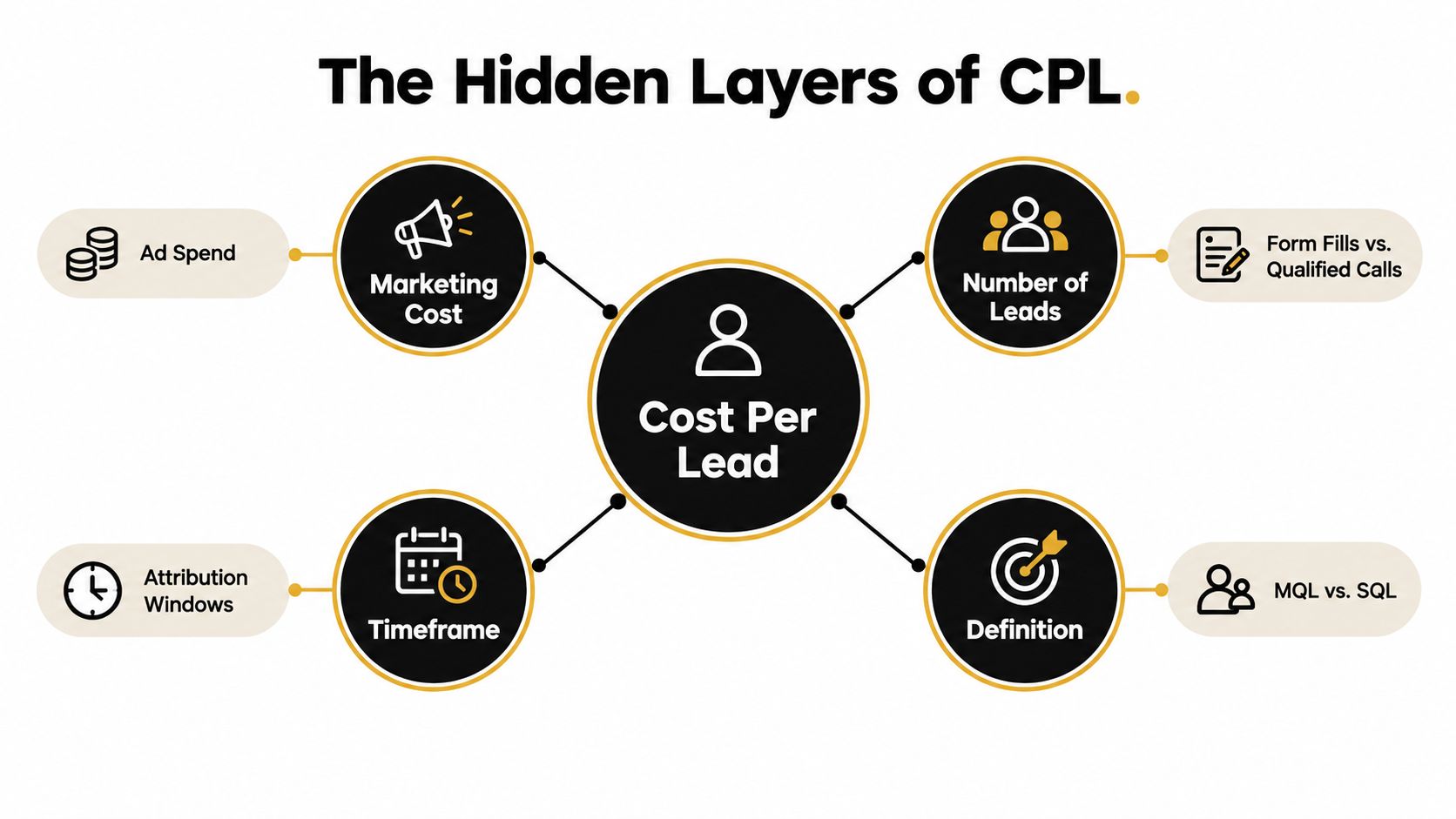
A paid campaign might count a lead when someone submits a form. A sales team might count only booked calls. A SaaS founder could reasonably define a lead as a free-trial signup, an activated user, or a sales-qualified opportunity. Each definition produces a different CPL, even when the campaign and spend stay exactly the same.
A newsletter subscriber and a buyer who requests implementation details aren't economically equivalent. Neither is a casual Reddit responder and a prospect who matches your ideal customer profile, explains their problem, and agrees to evaluate your product.
If you want a practical explanation of how the broader process works, learn how lead generation works. The important point is that lead capture is only one stage in a longer system.
Define the event before calculating the ratio
Write your lead definition in one sentence before opening a dashboard:
A lead is a person or account that has completed [specific action] and meets [specific qualification].
For a self-serve SaaS product, that might be a new trial user who reaches an activation milestone. For a sales-assisted product, it might be a booked call with a target account. For community-led acquisition, it could be a person who replies to a useful comment and accepts a product conversation.
Your definition should also specify the attribution window. A person who sees a Reddit discussion, searches for your brand later, and signs up directly may still be influenced by the original interaction. Whether you credit that interaction depends on the measurement rule you choose.
Know what CPL leaves out
Raw CPL doesn't tell you:
- whether the lead matches your market
- whether the contact is reachable
- whether the user activates
- whether sales accepts the lead
- whether the account becomes an opportunity
- whether the customer generates enough gross profit to recover acquisition cost
That makes CPL a diagnostic metric, not a final business verdict. Use it to find changes in acquisition efficiency, then connect it to qualification, activation, customer conversion, and payback.
The CPL Formula and How to Use It
Start with the complete version:
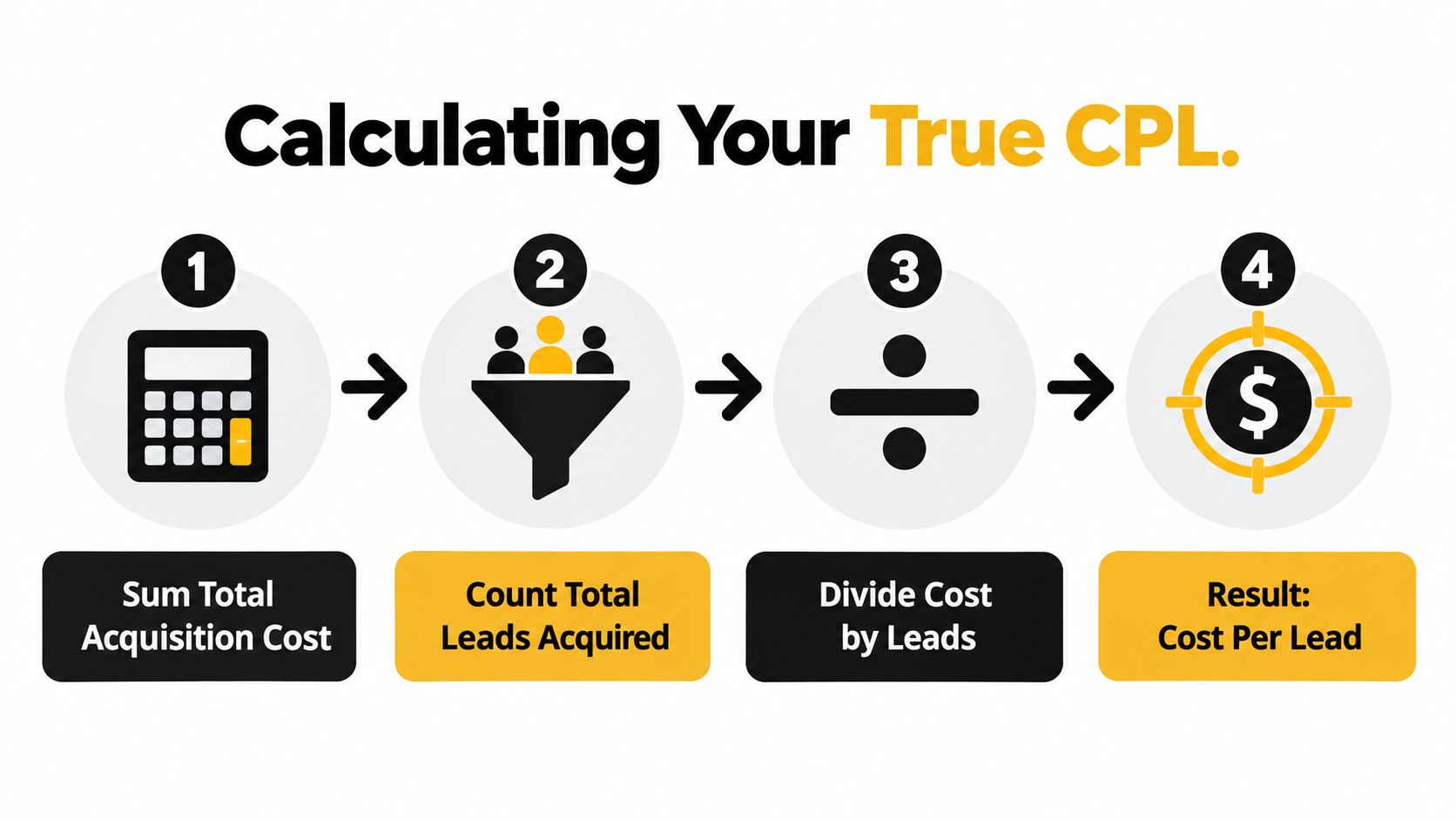
CPL = total acquisition cost ÷ total defined leads
For paid search, the same relationship can be expressed as:
CPL = CPC ÷ conversion rate
That relationship is useful because it isolates the two levers you can manage. If clicks become more expensive, CPL rises unless the page converts better. If the page converts more visitors, CPL falls when CPC stays constant.
Suppose a campaign has a $2 CPC and a landing-page conversion rate of 4%. The calculation is:
$2 ÷ 0.04 = $50 CPL
That result describes the cost of a defined conversion, not necessarily a qualified opportunity. If the form accepts anyone and sales later rejects most submissions, the campaign's meaningful cost is higher.
Include costs that don't appear in the ad account
Organic acquisition creates a different trap. Reddit traffic may have no direct media charge, but it still consumes founder time, moderation, research, content production, software, and follow-up capacity.
For example, imagine you spend $300 on tools and assign $700 of internal labor to a Reddit program. If the program produces 20 defined leads, your real CPL is:
($300 + $700) ÷ 20 = $50
The exact numbers are an illustration. The method is the point. A zero-dollar media report doesn't mean zero acquisition cost.
Track each channel with a consistent cost ledger:
- Media: ad spend, sponsorships, or promotion fees
- Labor: campaign management, writing, sales development, and moderation
- Tools: analytics, enrichment, automation, and CRM costs
- Creative: landing pages, design, video, and copy production
- Follow-up: sales time spent contacting and qualifying prospects
For the next layer beyond lead cost, use this practical guide to how to measure CAC for SaaS. CPL helps explain the front of the funnel. CAC tells you what it costs to produce a customer.
You can also use a customer acquisition cost calculator to keep channel comparisons consistent. Don't compare one channel using media spend alone with another channel that includes labor and tooling.
Real CPL Benchmarks by Channel and Funnel Stage
A $35 lead can be expensive. A $395 lead can be cheap. The difference is funnel stage, buying intent, and what your team counts as a real opportunity.
Benchmarks help you set a sane range, but only if you match the benchmark to the stage you are buying. Different studies define a lead differently, bundle unlike channels together, and blur the line between an email signup, a demo request, and a sales-ready account.
One independent B2B benchmark reports these median CPLs by channel B2B benchmark data:
| Channel | Median CPL (USD) | Funnel Stage | Typical Lead Quality |
|---|---|---|---|
| Content marketing and SEO | $35 | Top to middle | Research-driven, intent varies |
| $42 | Middle | Depends on list quality and engagement | |
| Paid search | $116 | Middle to bottom | Often stronger active intent |
| $152 | Top to middle | Precise targeting, mixed readiness | |
| Display | $180 | Top of funnel | Broad awareness and retargeting |
| Trade shows | $395 | Middle to bottom | Often richer context, high operating cost |
Read that table carefully. It is not a pricing menu for leads. A content lead may be an early researcher. A paid search lead may already be comparing vendors. A trade show lead may come with richer context and a real conversation behind it, even if budget or urgency is still unclear.
The same benchmark source places top-of-funnel B2B leads broadly at $65 to $250, with SaaS leads around $65 to $85, and bottom-of-funnel Google Ads CPL at $300 to $750. LinkedIn Ads can run $350 to $800 or more when you are targeting later-stage opportunities with tighter verification and more sales complexity.
That spread is the point. A benchmark only matters when the stage and lead definition match your own funnel.
Use benchmarks as ranges, not budgets
For a self-serve SaaS offer priced at $99 per month, copying a form-fill target from an enterprise demand gen team is a fast way to misread performance. Cheap top-of-funnel leads can flood the CRM and still hurt the business. What matters is whether those leads become activated users, qualified pipeline, and customers at a reasonable cost.
Map every benchmark to the stage it describes:
- Conversation: someone engages with a relevant message.
- Qualified opportunity: the account fits your market and shows a meaningful buying signal.
- Activated trial: the user reaches the product milestone linked to value.
- Customer: the account pays.
- Profitable customer: gross profit supports the acquisition cost and payback requirement.
If your team mixes those stages, your CPL benchmark is noise. Use a complete sales funnel guide to align marketing and sales on definitions first. Then run your own performance benchmarking by stage and cohort using the same attribution rule, time window, and qualification standard every time.
That is how you separate cheap clicks from lead economics that hold up.
Why Raw CPL Can Lie to You
The cheapest lead often looks attractive because it gives the dashboard an immediate win. That win can hide a broken qualification system.
Consider two channels. Channel A produces leads at $80 each, but only 10% become sales-qualified. Its effective cost per SQL is:
$80 ÷ 0.10 = $800
Channel B produces leads at $150 each, and 30% become sales-qualified:
$150 ÷ 0.30 = $500
Channel B has the higher raw CPL and the lower qualified-lead cost. If the sales team can convert those SQLs at a similar rate, the apparently expensive channel is economically stronger.
Qualification belongs inside the calculation
Use this formula:
Cost per qualified lead = raw CPL ÷ qualification rate
The same logic applies to activation and customer conversion:
- Cost per activated trial = channel cost ÷ activated trials
- Cost per customer = channel cost ÷ new customers
- Gross-profit CAC = acquisition and sales cost ÷ customers, assessed against gross profit
A channel that generates many unqualified contacts forces your team to spend time sorting, enriching, emailing, and disqualifying them. Those labor costs rarely appear in the platform report, but they reduce the channel's actual efficiency.
The minimum acceptable CPL report includes the qualification rate. Without it, you're measuring contact collection, not pipeline creation.
Reddit-led acquisition makes this especially important. A useful conversation can create a click, a delayed branded search, a direct visit, or a private message. Some visitors will never fill the first form, while others may arrive later through another channel. If you optimize only for immediate form submissions, you'll reward shallow responses and penalize conversations that create intent over time.
Use raw CPL to spot acquisition changes. Use qualified-lead cost, activation rate, customer conversion, and payback to decide whether to scale.
What Actually Moves Your CPL Up or Down
Your CPL rises or falls when one of four inputs shifts: the cost to reach the audience, the share of visitors who convert, the bar you set for qualification, or the way your tracking credits conversions. If you only watch the form-fill number, you will miss the reason it changed and react to the wrong lever.
Paid acquisition usually gets more expensive for a simple reason. More advertisers chase the same attention. CPC goes up, and CPL follows unless your page converts enough of that traffic to absorb the increase.
The second lever is the landing page. Strong message match, relevant proof, fast load time, fewer distractions, and lower form friction can push more visitors into the lead bucket. That only helps if lead quality holds. A page that converts everyone and filters no one often lowers raw CPL while raising qualified lead cost.
Audience selection affects both cost and quality. Broad targeting can buy cheap clicks from people with weak intent. Tight targeting can raise click costs while improving fit. Choose the mix that produces qualified pipeline, not the mix that makes the dashboard look cheap.
Higher CPL can coexist with better efficiency
Google Ads is a good example. In a 2025 analysis of 16,446 U.S. campaigns, average conversion rate increased from 6.96% to 7.52%, while average CPL rose from $66.69 to $70.11, a 5.13% increase. Search Engine Land reports the comparison.
The takeaway is straightforward. Better conversion efficiency did not cancel out tougher auction economics. Treat the higher nominal cost as acceptable only when the additional leads activate more often or produce faster payback. Otherwise the auction is charging you for volume you cannot convert.
Review these variables every week
- CPC: Is the auction getting more expensive?
- Landing-page conversion: Did message match or page friction change?
- Qualification rate: Are more submissions failing your criteria?
- Activation rate: Do new users reach value inside the product?
- Opportunity rate: Which sources create sales conversations?
- Attribution coverage: Are delayed or assisted conversions being captured?
- Lead-to-customer rate: Does the channel produce revenue, not just contacts?
Check email validity before new leads hit sales sequences. An Email Validation API can reduce invalid contacts and protect follow-up efficiency. It does not solve qualification. A deliverable address can still come from the wrong company, the wrong role, or the wrong buying stage.
Strategies to Lower CPL Without Killing Lead Quality
Lowering CPL isn't a single bid adjustment. It's a system of targeting, conversion, qualification, and measurement decisions.
Start with exclusions. Remove existing customers, irrelevant industries, unsuitable company sizes, job functions outside the buying group, and audiences that repeatedly fail qualification. A smaller audience can be more efficient when it removes expensive noise.
Test the landing page before changing the channel. Keep the campaign stable and test one meaningful variable, such as the headline, proof section, call to action, or form length. If CPC remains stable and the page converts more visitors, the formula improves without buying more traffic.
Turn organic language into paid creative. Review the questions and objections prospects already use in Reddit communities, sales calls, and support tickets. Use their language in ad headlines and landing-page copy, then judge the result by qualified leads rather than clicks.
Add an organic layer. SEO, communities, email, and founder-led distribution can reduce dependence on auctions, but don't pretend they are free. Record research, writing, moderation, and follow-up time. For a team considering Reddit as one channel, Bazzly can monitor relevant conversations, identify high-intent threads, draft context-aware replies, and support direct messages. Treat the subscription and operating time as acquisition costs.
Qualify earlier, not later. Add one or two useful fields that reveal fit, such as company type, use case, current workflow, or implementation timing. Don't create a long interrogation. Ask only questions that change routing or follow-up.
Use channel-specific attribution. Paid channels often capture demand created by organic content, community discussions, or brand activity. Compare first touch, last touch, assisted touch, and cohort outcomes. Don't cut a channel merely because it wasn't the final click.
A practical weekly experiment might look like this:
- Choose one channel with enough activity to diagnose.
- Identify whether the problem is CPC, conversion, qualification, or activation.
- Change one variable.
- Keep the lead definition fixed.
- Review qualified-lead cost and customer progression, not just raw CPL.
The goal isn't the lowest possible number. The goal is a repeatable acquisition system that produces customers at a cost your margins can support.
Building Your Own CPL Decision Framework
Use four decisions to determine whether your lead generation cost per lead is good.
Define the lead
Choose one primary lead event for the current stage of your business. A self-serve SaaS team may use an activated trial. A sales-led team may use a qualified meeting. Document what doesn't count.
Calculate three layers
Track raw CPL, cost per qualified lead, and cost per customer. Add activation rate and lead-to-customer rate so a cheap source can't hide weak downstream performance.
Set the economic ceiling
Your maximum acquisition cost must fit gross margin, retention, and payback requirements. A channel can be worth scaling with a higher CPL when it produces stronger activation, better customers, or faster payback. Cut it when those downstream outcomes don't justify the spend.
Review cohorts, not snapshots
Review new leads by source, campaign, qualification status, activation, and paid conversion. Give delayed conversions enough time to appear, then compare channel cohorts using the same rules.
Benchmarks will keep shifting through 2026, but the decision won't change. Founders who win won't chase a universal CPL. They'll know exactly which lead they're buying, what that lead becomes, and how much customer acquisition cost the business can afford.
Take your last campaign and calculate three numbers today: raw CPL, qualified-lead cost, and customer cost. If you only have the first, your dashboard is incomplete.
Bazzly helps founders and small SaaS teams monitor relevant Reddit conversations, identify high-intent opportunities, draft context-aware replies, and support personalized direct messages. Visit Bazzly to see whether a Reddit acquisition workflow can fit your qualified-lead cost model.


