How Does Lead Generation Work? a Complete Guide for Startups
A founder launches a product, watches the form notification count climb, and assumes the hard part is over. A few weeks later, the CRM is full of email addresses, sales calls produce polite deferrals, and nobody can explain why a campaign that generated “hundreds of leads” created almost no pipeline.
That situation is common because teams often measure lead capture instead of sales readiness. The answer to “how does lead generation work?” isn't just “drive traffic and collect contact details.” It's a coordinated system that attracts the right people, identifies meaningful intent, develops trust during research, and routes qualified opportunities to sales at the right moment.
Table of Contents
- What Lead Generation Actually Means for Startups
- The Multi-Stage Funnel and Where Leads Actually Drop Off
- Why the Linear Funnel Model Is Broken for Modern Buyers
- Choosing Channels That Actually Generate Sales-Ready Leads
- Using AI and Signal-Based Scoring to Prioritize High-Intent Leads
- Building a Repeatable Lead-Gen System with Reddit Marketing
- Why Execution Quality Matters More Than Channel Hopping
- Your Step-by-Step Lead Generation Launch Checklist
What Lead Generation Actually Means for Startups
A startup founder might launch an ebook, promote it on social media, and celebrate when downloads arrive. The campaign appears successful until sales asks a basic question: how many of these contacts fit the target market, have a relevant problem, and are likely to consider a purchase?
That question changes the definition of lead generation. A lead isn't valuable because a form captured an email address. A lead is valuable when the business can understand its fit, intent, and next action. Lead generation is therefore a measurable operating system, not a single campaign or one-time acquisition task.
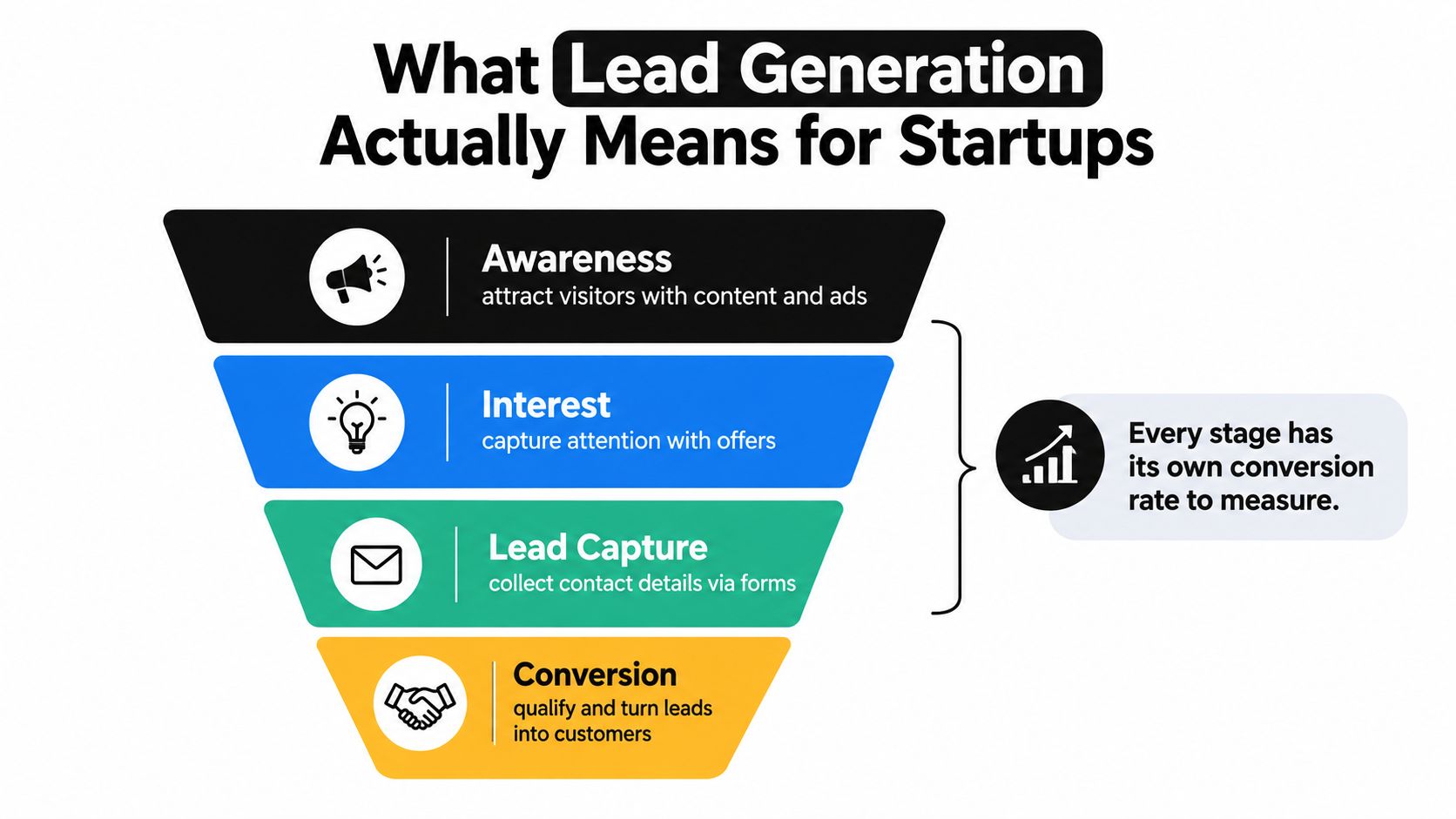
The system usually contains four connected movements:
- Attract: Bring relevant people to content, product pages, communities, or events.
- Capture: Offer a useful next step that earns permission to continue the conversation.
- Qualify: Distinguish curiosity, research, and genuine buying intent.
- Convert: Help sales or self-serve buyers complete the path to revenue.
The metric that exposes the real problem
Recent B2B benchmarks put median website conversion at 2.9%, or roughly 29 leads from 1,000 visitors, while only 9.8% of MQLs became SQLs in 2026. The same benchmark reports a 0.94% average lead-to-customer conversion, meaning approximately one in 106 captured leads became closed-won revenue. The benchmark data behind these funnel metrics makes the practical lesson clear: acquisition and qualification must work together.
A startup that doubles form submissions without improving fit may just double the work for sales. The better question is whether each stage produces a stronger pool for the next one. That means tracking source, account fit, problem relevance, engagement quality, MQL acceptance, SQL creation, opportunity progression, and revenue, rather than treating every contact as equal.
Practical rule: A lead-generation program isn't working when it produces the most contacts. It's working when sales receives opportunities it can act on.
The Multi-Stage Funnel and Where Leads Actually Drop Off
Lead generation starts before the form and continues after it. A visitor may arrive through search, a recommendation, a social post, or a direct referral. That visitor becomes a lead after taking an identifiable action, then may become an MQL when marketing sees enough fit and engagement to justify further attention. An SQL is a narrower category, where sales agrees that the prospect is ready for a meaningful sales conversation.
The important point is that each transition has a different failure mode.
A working model of the stages
| Stage | What the team is trying to learn | Common failure |
|---|---|---|
| Visitor or account | Is this person or company relevant? | Traffic looks large but has weak fit |
| Lead | Did the prospect exchange contact details for value? | The offer attracts researchers with no buying need |
| MQL | Does engagement and profile fit justify nurturing? | A single low-intent action triggers qualification |
| SQL | Is there a credible reason for sales to engage now? | Marketing hands over interest that sales can't progress |
| Opportunity | Is there a defined problem, process, and buying path? | The conversation never becomes a commercial evaluation |
Across 100M+ data points and 14 industries, one benchmark set reported an average qualified-lead conversion rate of 2.9%. It also reported median MQL-to-SQL conversion of 13%, with top-quartile teams converting at more than twice the median rate. The 2026 qualified-lead benchmark analysis supports a conclusion many startups resist: the biggest opportunity often sits after capture.
Why more traffic rarely fixes qualification
Traffic is visible, easy to report, and emotionally satisfying. Qualification is slower and messier. It requires a clear ideal customer profile, useful behavioral signals, agreed definitions between marketing and sales, and follow-up that reflects the prospect's situation.
A founder can improve the funnel by tightening the offer, adding disqualifying questions, separating educational downloads from commercial actions, and building nurture paths around the problem the prospect is researching. Those changes may reduce raw lead volume while improving the quality of sales conversations.
The right optimization sequence is to find the weakest handoff, understand why prospects disappear, and improve that transition before buying more traffic. If MQLs rarely become SQLs, another acquisition campaign won't solve the underlying problem. It will only make the qualification backlog larger.
Why the Linear Funnel Model Is Broken for Modern Buyers
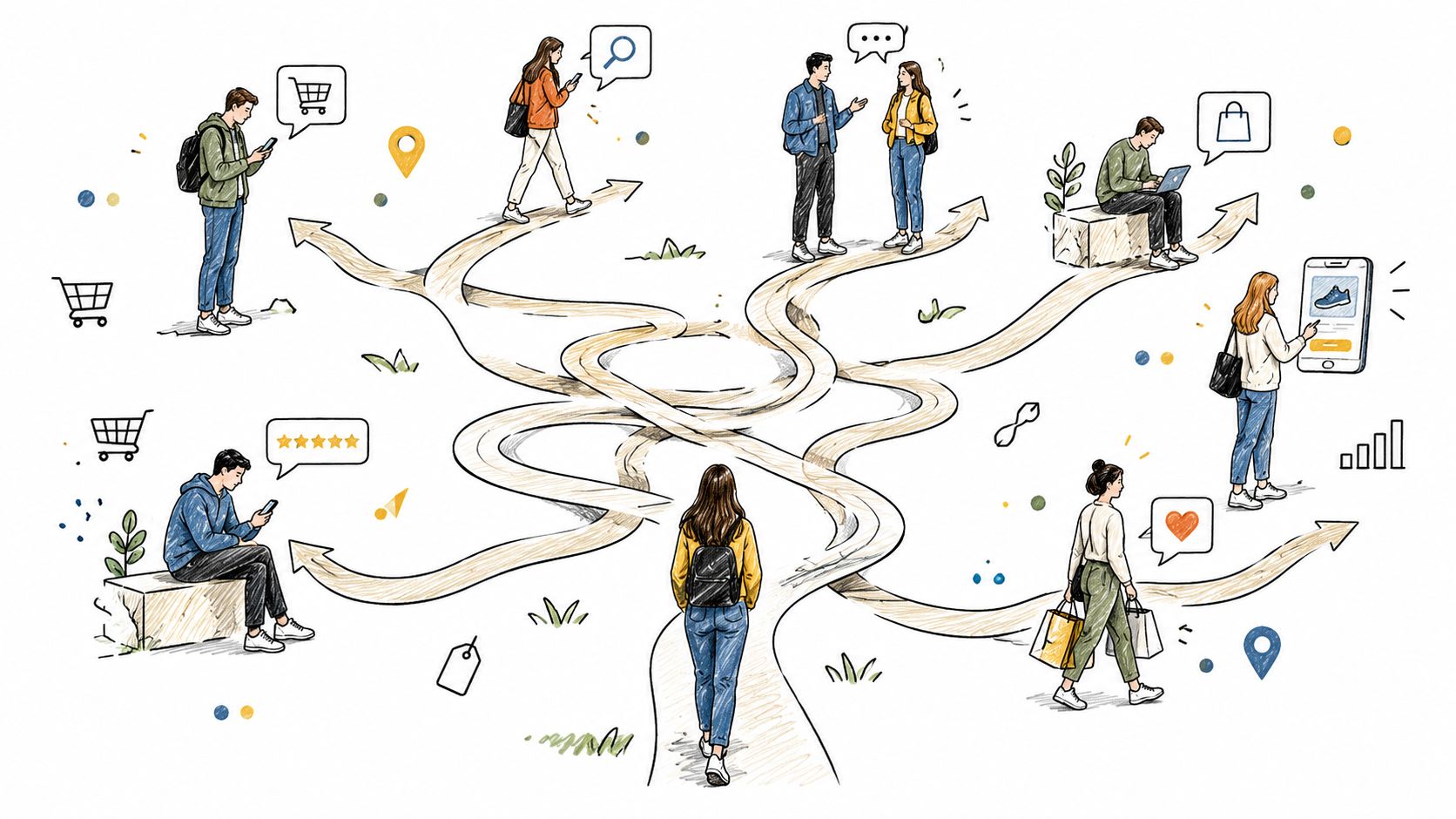
The classic funnel suggests a tidy sequence. A buyer sees a message, visits a website, fills out a form, speaks with sales, and purchases. Real B2B buying is less cooperative. Several people may research independently, compare alternatives, ask peers for advice, and revisit a product without identifying themselves.
Research cited in current B2B benchmarks reports that buyers spend only 17% of their total buying time in direct contact with vendors, while about 80% of the journey is self-directed. It also reports that 61% prefer a rep-free buying experience. The buyer-journey data and MQL-to-SQL trend explain why a form-first strategy misses much of the decision process.
Build for the research phase
A startup can't see every anonymous visit, but it can make independent research more useful and easier to continue. Start by mapping the questions buyers ask before they compare vendors:
- Problem recognition: What makes the prospect search for a solution?
- Approach evaluation: Which methods, workflows, or categories do they consider?
- Vendor comparison: What proof, integrations, risks, and trade-offs influence selection?
- Internal alignment: What does a champion need to explain to a manager, finance team, or technical reviewer?
Create content for those questions instead of publishing only product announcements. A comparison page may help a buyer evaluate options. A practical template may reveal the problem's urgency. A technical explanation may give an internal champion material to share with colleagues.
Turn anonymous interest into useful signals
You don't need to identify every reader immediately. Group behavior into intent patterns. Repeated visits to commercial pages, interaction with implementation material, return visits from a target account, or a request for a product-specific resource can justify a different experience than a casual article view.
The handoff should also preserve context. Sales needs to know which problem the prospect explored, what asset prompted the conversion, which company attributes match the target profile, and what action would be useful next. A generic “new lead” notification forces the buyer to repeat themselves and forces the seller to guess.
The median MQL-to-SQL rate in the cited benchmark fell from 13.1% in 2024 to 9.8% in 2026, a pattern consistent with programs that reward activity before readiness. The response isn't to hide the funnel. It's to make readiness a shared operating definition.
Choosing Channels That Actually Generate Sales-Ready Leads
Channel selection should follow buyer behavior and the type of evidence a prospect needs. A channel can generate cheap attention while producing weak opportunities, or it can reach fewer people while creating conversations with clear commercial context.
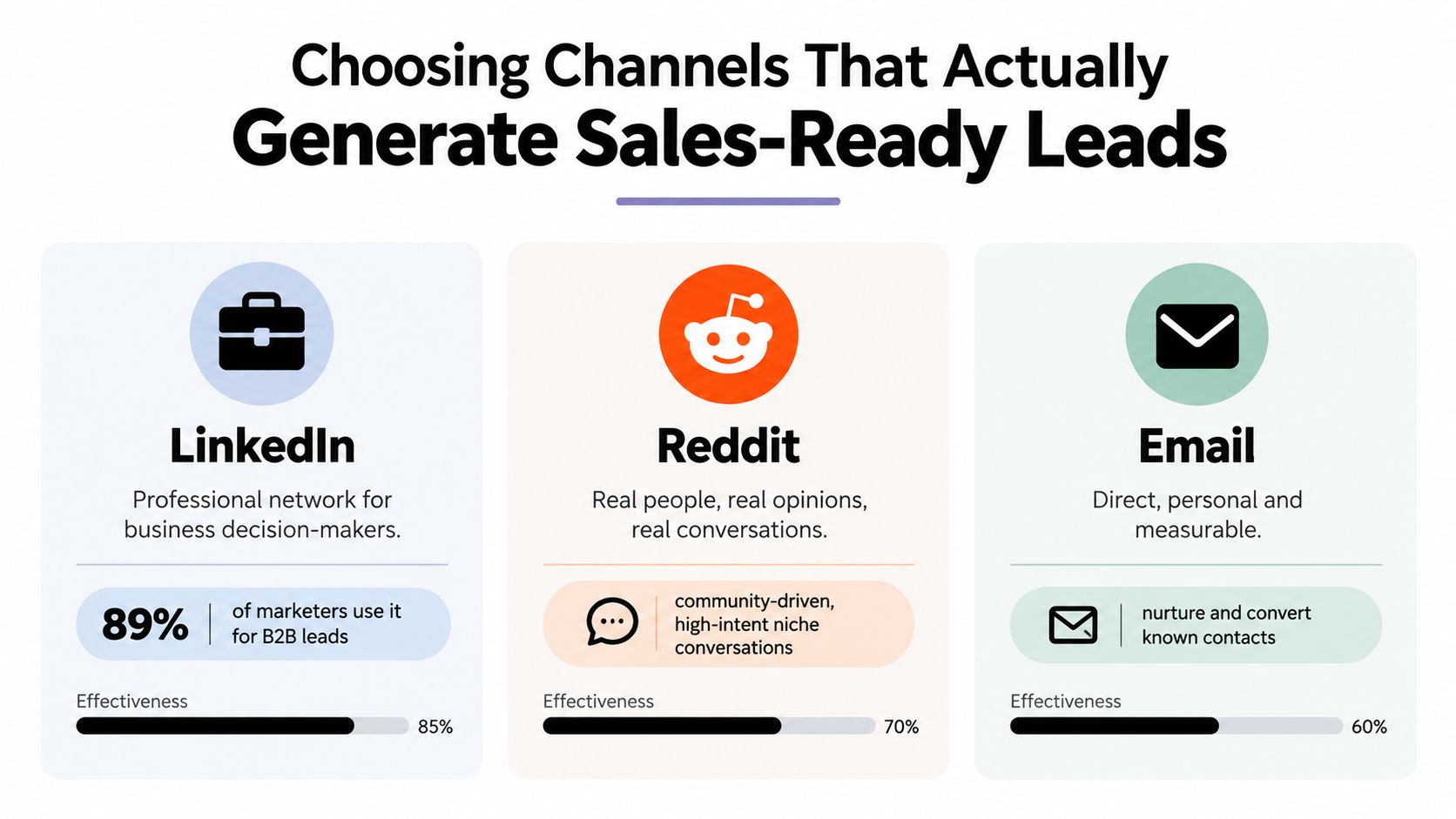
LinkedIn has become the dominant social platform for B2B lead generation in the cited benchmarks. 89% of B2B marketers use it, 62% say it generates leads effectively, and LinkedIn-originated leads account for about 80% of social-media B2B leads. Content marketing, meanwhile, is reported to produce roughly three times more leads than traditional outbound at 62% lower cost. The channel and nurturing benchmarks show why startups should compare channels by downstream quality, not just top-line response.
Match the channel to the job
| Channel | Strong use | Trade-off |
|---|---|---|
| Reaching defined professional audiences and building account familiarity | Competition for attention can make generic outreach ineffective | |
| Search and content | Capturing existing questions and supporting self-directed research | Compounding demand takes time and requires consistent quality |
| Nurturing known contacts with relevant next steps | Poor segmentation turns useful follow-up into noise | |
| Communities | Joining problem-specific conversations where intent is visible | Trust disappears quickly when replies feel automated or promotional |
| Outbound | Creating focused conversations with a defined account list | Personalization and research make it labor-intensive |
Nurturing deserves its own attention. The cited research reports that lead nurturing can generate 50% more sales-ready leads at 33% lower cost, while content marketing can outperform traditional outbound on both lead volume and cost. Those comparisons don't mean every startup should abandon outreach. They mean a balanced system pairs targeted outbound with assets that help buyers evaluate the problem independently.
Teams that need a more deliberate operating model can build cross-channel systems with Lead Printer, particularly when they want to coordinate prospecting, content, and follow-up rather than run isolated campaigns. For a SaaS-specific view of channel planning and handoffs, see this guide to SaaS lead generation.
Make one channel accountable
Don't launch every channel at once. Choose one acquisition channel that fits the audience, one conversion offer that reveals useful intent, and one nurture path that helps the buyer make progress. Measure accepted MQLs, SQLs, opportunities, and revenue by source. If a channel creates engagement but no qualified movement, change the offer or audience before declaring the channel a failure.
Using AI and Signal-Based Scoring to Prioritize High-Intent Leads
A scoring model should answer a practical question: who deserves attention now, and why? It shouldn't turn every click into a sales alert. A prospect who matches the target account profile but only reads introductory content may need education. A prospect who returns to pricing material, evaluates implementation details, and engages from a target company may warrant timely outreach.
In 2026, the median B2B cost per lead reached $213, compared with $198 in 2025, and the gap between top and bottom performers widened to 4.7 times. At the same time, 61% of B2B teams use AI for lead scoring, up from 23% in 2024. The benchmark on cost, performance gaps, and AI scoring points to a useful distinction: technology matters, but disciplined execution matters more.
Combine fit, behavior, and timing
A durable scoring system uses three signal groups:
- Fit signals: Industry, company size, role, geography, use case, and technical environment.
- Behavior signals: Pages viewed, content consumed, product actions, replies, event participation, and return visits.
- Timing signals: Recent activity, a new relevant initiative, a hiring pattern, a public problem, or a direct request for help.
AI can help classify patterns across these inputs, summarize account activity, and flag changes that a small team might miss. It shouldn't replace the underlying rules. Marketing and sales still need to decide which behaviors indicate education, active evaluation, or disqualification.
Connect scoring to action
Every score band should have a response. Low-intent contacts can enter an educational sequence. Qualified accounts can receive role-specific material. High-intent prospects can trigger an alert with a recommended message and the context behind it.
A founder evaluating AI lead generation tools should ask whether the tool improves prioritization or merely produces more automated activity. The useful output is not a mysterious score. It's a reasoned recommendation, such as “this account matches the target profile, revisited the implementation page, and responded to a problem-specific message.” That explanation helps a salesperson act without losing judgment.
Building a Repeatable Lead-Gen System with Reddit Marketing
Reddit can work as a lead source when a product solves a problem people already discuss in public. The operating principle is simple: find conversations where the problem is explicit, contribute a useful answer, and make the next step relevant. A product mention should support the discussion, not replace it.
A repeatable workflow begins with setup. Define the customer profile, list the communities where those buyers ask questions, identify language associated with the problem, and decide which topics are outside the brand's expertise. Configure monitoring around those signals, then review early matches manually so the system learns the difference between genuine intent and casual discussion.
Turn conversations into qualified opportunities
A useful Reddit workflow has distinct stages:
- Monitor: Find threads that contain a specific pain point, comparison, request, or workaround.
- Classify: Separate buying intent from general advice, support questions, and unrelated traffic.
- Draft: Prepare a context-aware response that answers the question before mentioning a product.
- Review: Check tone, community rules, factual accuracy, and whether the recommendation fits.
- Publish: Use an appropriate account and avoid repeating identical language across communities.
- Route: Record the conversation, response, and follow-up path so interested people don't disappear.
The value comes from context. A person asking for alternatives to a workflow has a different need from someone debating a broad category. The first may be comparing solutions. The second may still be defining the problem. Treating both as immediate sales leads creates poor conversations and damages community trust.
The practical mechanics of finding and responding to relevant discussions are covered in this guide to Reddit lead generation.
The later follow-up should remain specific to the thread. If someone asks a question, answer it directly. If they request a demonstration, offer the appropriate next step. If they stop responding, don't turn a helpful exchange into a sequence of generic reminders.
Why Execution Quality Matters More Than Channel Hopping
Founders often change channels when the actual problem is weak execution. A new platform feels like progress because it creates fresh activity, but activity doesn't repair an unclear offer, poor targeting, slow follow-up, or a broken handoff to sales.
The cited benchmark places median B2B cost per lead at $213 in 2026, up from $198 in 2025, with a 4.7x gap between top and bottom performers. That spread suggests that channel choice alone can't explain results. The same channel can produce very different outcomes depending on audience definition, message quality, qualification rules, and response process.
Improve the system before expanding it
A focused startup should make one channel more useful before adding another. Review the path from first interaction to sales conversation:
- Message: Does the copy describe a problem the target buyer recognizes?
- Offer: Does the conversion asset help the buyer make progress?
- Qualification: Does the form or follow-up reveal fit and urgency?
- Routing: Does the right person receive the lead with enough context?
- Response: Does the next message reflect what the prospect did?
- Measurement: Can the team connect the source to qualified pipeline?
Weakness in any one step can make a strong channel look ineffective. A high-performing content program still fails if sales treats every download as a buying signal. A good outbound list still underperforms if messages describe the company instead of the prospect's problem.
The fastest growth lever is often a better decision about which leads not to pursue.
Choose depth over novelty
Channel hopping also prevents learning. When a team constantly changes tactics, it can't tell whether performance changed because of the audience, creative, offer, timing, or follow-up. Keep the test narrow, document the assumptions, and judge the result by qualified movement rather than impressions or contact volume.
The goal isn't to generate a perfect stream of leads. It's to create a dependable path from recognizable problem to useful conversation. Once that path produces consistent learning, a second channel can extend it. Before then, it usually adds noise.
Your Step-by-Step Lead Generation Launch Checklist
A reliable launch starts with definitions, not software. Write down the target customer, the problem that creates urgency, the evidence that indicates fit, and the event that should move a contact from marketing attention to sales attention. If marketing and sales use different definitions, the dashboard will only make the disagreement more visible.
Establish the operating foundation
- Describe the buyer: Document the company profile, roles involved, trigger problems, objections, and alternatives already under consideration.
- Map the journey: List the questions buyers ask before contact, during evaluation, and before internal approval.
- Choose the initial channel: Select the source that matches how the audience researches and communicates.
- Create the conversion path: Pair a useful offer with a focused landing page, clear CTA, and confirmation experience.
- Define qualification: Specify the fit and behavior required for an MQL, SQL, and opportunity.
- Assign ownership: Decide who reviews new leads, who follows up, and what happens when a lead isn't ready.
Instrument the handoffs
Track the movement between stages rather than relying on a single conversion rate. At minimum, record source, offer, account fit, engagement context, qualification status, sales acceptance, opportunity creation, and closed revenue. Add a reason when sales rejects an MQL. Those reasons often reveal a targeting or messaging problem faster than a campaign report does.
Build a nurture path for contacts who show interest without clear readiness. Use educational material for problem discovery, practical guidance for evaluation, and product-specific information only when the prospect's behavior supports it. Keep the messages connected to the original intent so the sequence feels like assistance rather than a reset.
Run the improvement loop
Review the funnel on a fixed cadence. Find the stage with the largest quality problem, inspect real records, identify the repeated cause, and change one part of the system. That might mean revising the audience, removing an unhelpful offer, changing the qualification threshold, improving sales context, or shortening the path to a relevant conversation.
A startup doesn't need a complicated stack to begin. It needs clear definitions, honest measurement, useful content, timely follow-up, and the discipline to optimize for qualified opportunities instead of applause from a lead-count report.
Bazzly helps founders and small teams monitor Reddit conversations, identify high-intent threads, draft context-aware replies, and manage outreach through supported workflows. Visit Bazzly to see how it can fit into a lead-generation system built around real buyer intent rather than raw contact collection.


