SaaS Customer Acquisition: The Founder's Playbook
$2.00 in new CAC ratio is the median SaaS benchmark, and the weakest quartile spends $2.82 for every $1 of new ARR. If your payback is long, the problem isn't traffic, it's cash flow.
You can feel this fast. The product works, a few channels produce signups, and yet the bank balance never seems to relax because every new customer takes too long to pay back. That's the core constraint in saas customer acquisition, not a lack of leads, and it's why founders need to stop treating acquisition like a volume game.
Table of Contents
- Why Most Early-Stage SaaS Teams Get Acquisition Wrong
- The Core Metrics Every SaaS Founder Must Understand
- Acquisition Channels Compared for Cash-Efficient Growth
- Building a Funnel That Compounds Revenue
- A Reddit and Community Playbook for Early-Stage SaaS
- Measuring Acquisition When AI and Communities Steal the First Click
- Your 30-Day Founder Acquisition Plan
- Founder Questions That Come Up After Reading This
Why Most Early-Stage SaaS Teams Get Acquisition Wrong
A founder usually notices the problem after the first burst of momentum. The product gets talked about, demo requests come in, and a couple of campaigns look promising. Then the monthly burn tells the truth, because new revenue shows up too slowly to fund the next wave of acquisition.
That's where many teams make the wrong move. They ask for more traffic when they should be asking whether each channel produces enough gross profit, quickly enough, to justify scaling it. Payback months matter more than raw lead volume because runway is the thing that decides whether you get another quarter to learn.
What to watch before you scale anything
The single ratio to track weekly is CAC payback on a gross-margin basis. A customer that “costs less” can still be a bad acquisition if it takes too long to recover the spend after delivery costs. The reverse is also true, a channel with a higher upfront cost can be the smarter bet if it attracts buyers who activate faster and retain longer.
That's why I'd rather see a founder compare channels by new ARR produced per dollar invested than by clicks or signups alone. If you want a practical lens for what search-driven discovery looks like in this environment, start with understanding search SaaS platforms. It's a good reminder that visibility and economics are separate problems.
Practical rule: don't ask, “How do we get more leads?” Ask, “Which channel buys back its cost soon enough that we can keep going?”
The mistake isn't trying multiple channels. The mistake is scaling before you know whether you have a traction problem or an economics problem. If the product converts but the payback is long, that's not a traffic issue, it's a unit economics issue. Founder energy is better spent tightening the math than chasing another campaign that just adds more expensive noise.
The Core Metrics Every SaaS Founder Must Understand
A SaaS team can win signups and still burn cash if the acquisition math is wrong. CAC is the total sales and marketing spend needed to win one customer. LTV is the gross-profit value that customer produces over time. LTV:CAC shows whether growth is financeable. CAC payback months shows how long you wait before acquisition starts funding itself again.
Use gross margin, not revenue, as the baseline. A $100 customer acquisition cost is not recovered when the customer creates $100 in revenue. The spend is recovered only after gross profit covers it. For a clear walkthrough of that math, use this guide to B2B customer acquisition cost.
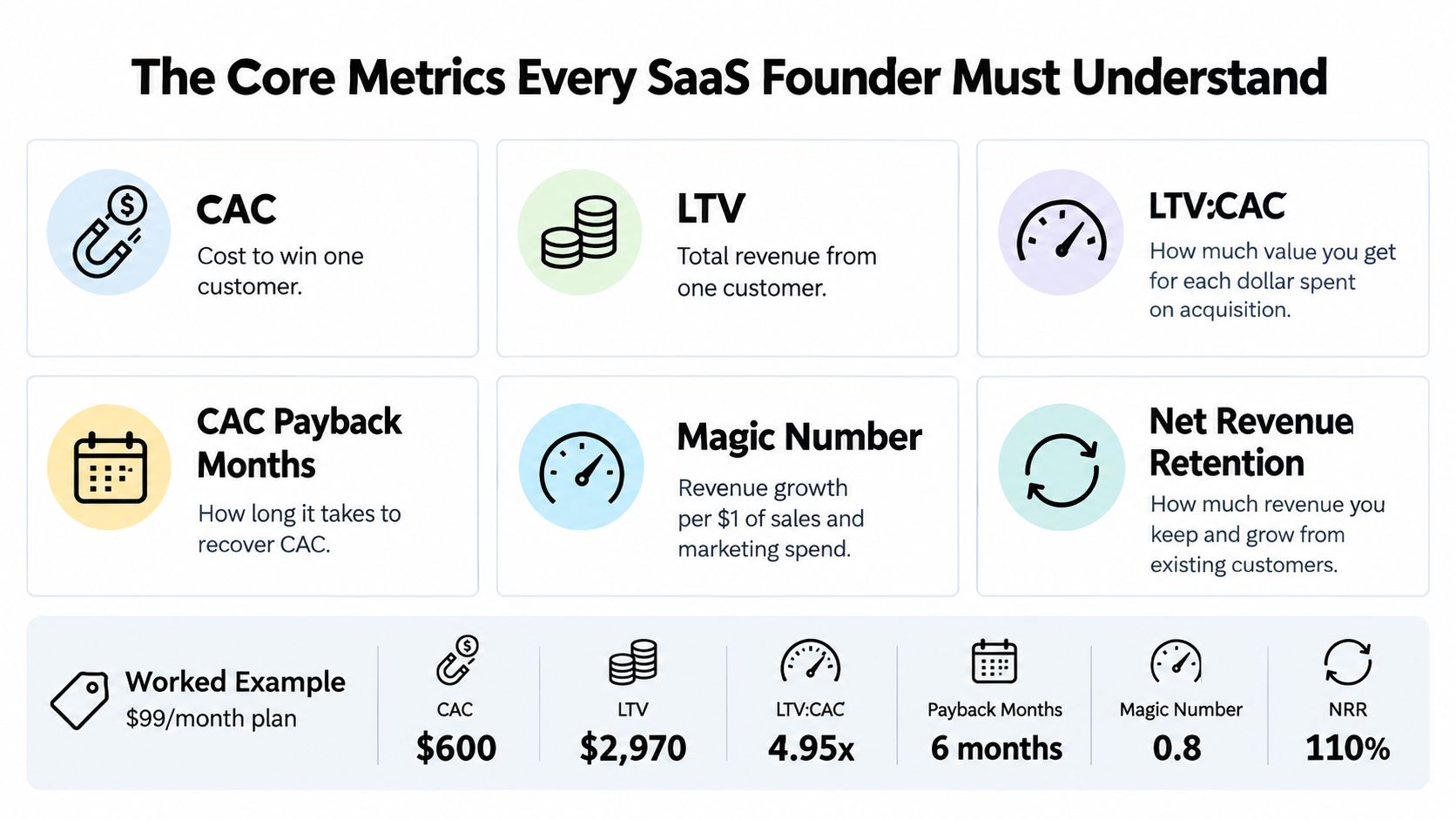
A $99/month plan with 80% gross margin and $300 fully loaded CAC produces monthly gross profit of $79.20, which gives a payback period of about 3.8 months (Pavilion benchmark report). At 50% gross margin, the same CAC stretches payback to about 6.1 months. Same spend, very different cash reality.
The numbers that actually change your decisions
Magic Number is a growth-efficiency sanity check. It helps you see whether marketing spend is producing durable revenue or just activity. Net Revenue Retention tells you whether existing customers are expanding enough to make acquisition less expensive over time. Weak retention makes every acquisition channel look worse.
For a $99 plan at 80% margin and an 18-month lifetime, gross-profit LTV is $1,425.60, and at a 3:1 threshold that supports an allowable CAC of about $475.20 (SaaSHero). That is your ceiling, not your target. Spend against that number, or you will buy growth you cannot sustain.
Benchmarks help only when you read them as a system. Benchmarkit via Omnibound reported that the median New CAC Ratio rose 14% during 2024 to $2.00, and the weakest quartile spent $2.82 for every $1 of new ARR (Benchmarkit via Omnibound). Acquisition is getting more expensive, so cash-efficient channels matter more, especially as discovery shifts through AI summaries, communities, and other first-touch paths you do not fully control.
Founder takeaway: know your CAC, payback, LTV:CAC, and retention before you debate channels. If those four numbers are not visible, you are guessing.
Keep one dashboard open with channel-level CAC, gross margin, payback months, activation rate, and cohort retention. Ignore aggregate numbers until you trust the channel data underneath them. That is how founders scale what works instead of funding noise.
Acquisition Channels Compared for Cash-Efficient Growth
Not every channel belongs in the same startup stage. A seed-stage founder selling a low-ACV product should not run the same acquisition plan as a later-stage team selling to a committee. The right choice depends on ACV, sales cycle, gross margin, and how quickly the channel teaches you something useful.
Here's the framework I use.
| Channel | Best Stage | Cost Shape | Time to Results | Intent Quality |
|---|---|---|---|---|
| SEO and content | Early to growth | Front-loaded, then compounding | Slow | High when it targets comparison and use-case intent |
| Paid search and paid social | Growth and scale | Ongoing spend | Fast | High for active demand, weaker for cold awareness |
| Partnerships and integrations | Early to growth | Mostly relationship cost | Medium | High when the partner audience overlaps your ICP |
| Outbound sales | Mid-market and above | Labor-heavy | Fast once the list is good | High if signals are real, weak if it's spray and pray |
| Community-led growth | Early-stage and niche markets | Low cash, high attention | Medium | Very high when the thread or group is already buyer-facing |
The useful comparison isn't “which channel is best.” It's “which channel fits the cash reality of this company right now.” Early-stage teams need channels that create learning, proof, and retained revenue, not just raw top-of-funnel activity. Mature teams can buy more speed once the economics are already proven.
How to choose without copying competitors
SEO and content compound when the category has stable questions and enough search intent to matter. Paid channels work when you already know what converts and can afford to pay for speed. Partnerships and community channels are stronger when trust matters more than volume, especially in categories where buyers want independent validation before they click a landing page.
For a deeper framework on channel mechanics, the science of customer acquisition is a useful background read. The key point is simple, channel fit matters more than channel popularity.
Outbound is different. It's useful when you have a crisp ICP and a reason to reach out, but it gets expensive fast if the list is loose. Community-led growth is often underestimated because it doesn't always look scalable on a spreadsheet, yet it can outperform paid when buyers discuss problems in public before they ever visit your site.
Pick two channels, maybe three. If you're running ten, you're probably buying confusion.
Bazzly is one example of a community-led workflow tool, it monitors Reddit conversations, drafts replies, and helps teams engage where intent is already visible. The point isn't the tool itself, it's that community channels deserve operational discipline, not casual posting.
Building a Funnel That Compounds Revenue
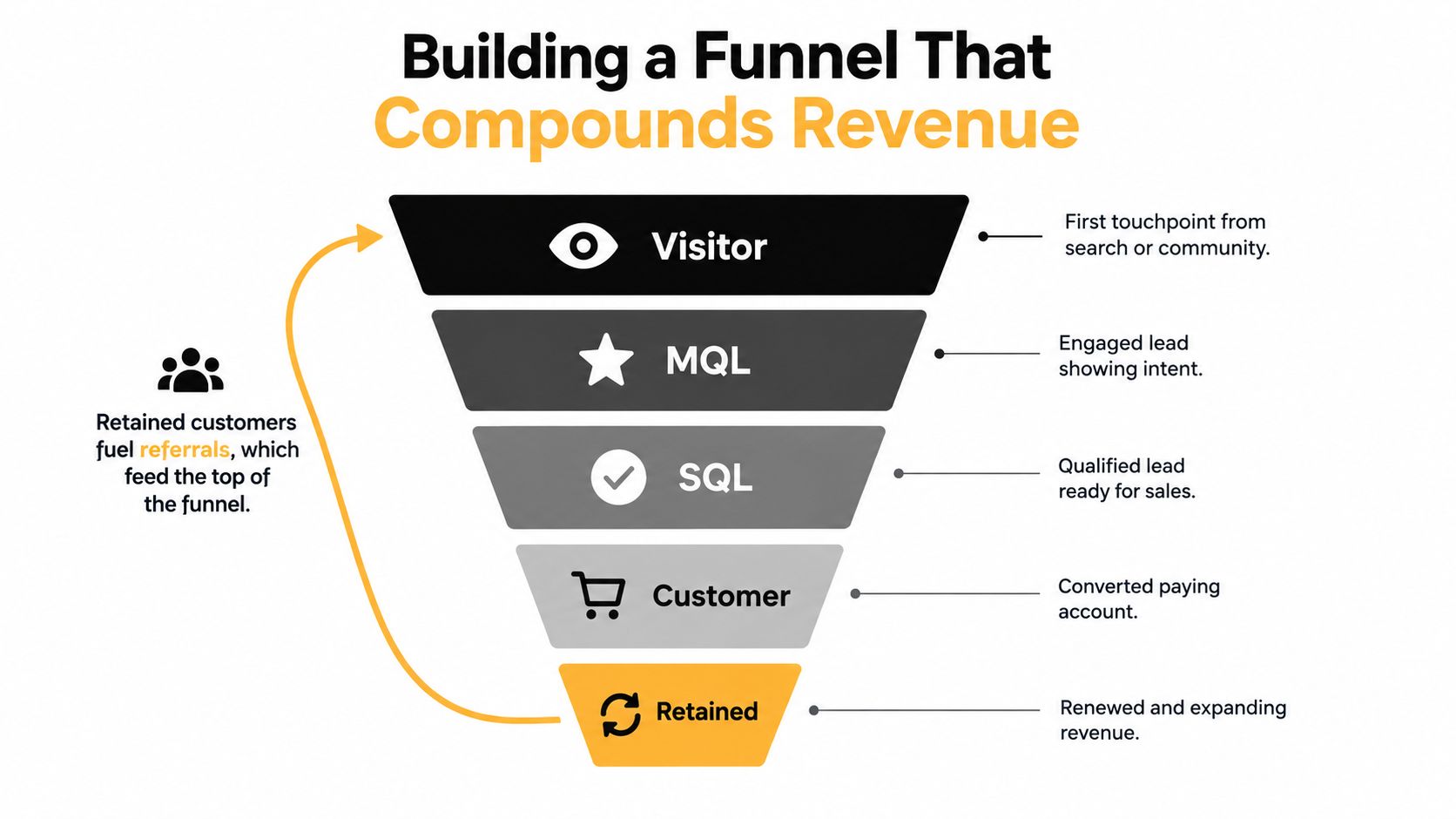
A funnel that only counts signups is a funnel that lies. The actual job is to move someone from first touch to activated use, then to paid status, then to retained and expanded revenue. If any stage is weak, the next channel just pours more water into a leaky bucket.
The useful sequence is visitor, MQL, SQL or activated signup, customer, and retained customer. Benchmarks for mature B2B processes place visitor-to-lead conversion around 1-3%, lead-to-opportunity around 10-15%, and opportunity-to-customer around 20-30%, but those numbers only matter if you connect them to retention and gross margin (SaaSHero).
Where founders waste time
Most founders obsess over visitor volume because it's the easiest number to move. That's usually the least useful place to spend time early on. A better use of effort is fixing the step that changes whether a visitor becomes activated, because activation drives both payback and LTV.
If you want to improve that middle of the funnel, boost trial conversion rates by making the product's value obvious earlier and reducing setup friction. That's often worth more than adding another traffic source.
The best debugging sequence is simple. First, check whether traffic is qualified. Then check whether the signup or trial activates. After that, look at paid conversion, churn, and expansion separately. Each stage deserves one decision, not five conflicting dashboard metrics.
Coaching note: if a metric doesn't tell you what to change this week, it's not the metric you need.
Early-stage founders should spend more time on activation than on top-of-funnel expansion. If activation improves, payback shortens, allowed CAC rises, and every channel gets easier to justify. That's how acquisition compounds, through product experience, not just more traffic.
A Reddit and Community Playbook for Early-Stage SaaS
Community channels are different because they don't stop at the platform. A good Reddit comment can rank in search, get cited in AI answers, and keep sending traffic long after the thread is old. That makes community a compounding asset, not just a place to “be present.”

Start with a narrow list of subreddits where the buyer already asks for help. Watch for trigger phrases, product comparisons, and “what are you using for” posts, then answer with context instead of pitch language. The thread should feel like a useful reply from someone who has actually worked the problem.
How to run it without looking robotic
Use aged accounts with real activity history. Post where your product is genuinely relevant, and keep the tone plain. If a thread shows real intent, follow up with a direct message that solves the problem instead of pushing a demo link first.
The workflow matters more than the tactic. Smart upvotes can help a good reply surface, but the comment still has to deserve attention. That's why teams need controls over targets, tone, and outreach timing, especially if multiple people are posting on behalf of the same company.
The platform side of this motion is where community-based marketing becomes operational instead of theoretical. If you're trying to understand how a product can show up inside AI-mediated discovery, how to appear in AI search results is the right companion read.
A sane community motion is small. Pick five to ten places, write replies that solve specific problems, and keep track of which conversations turn into clicks, DMs, and signups. If the comments drive attention but not qualified action, the audience fit is wrong or the answer is too generic.
Measuring Acquisition When AI and Communities Steal the First Click
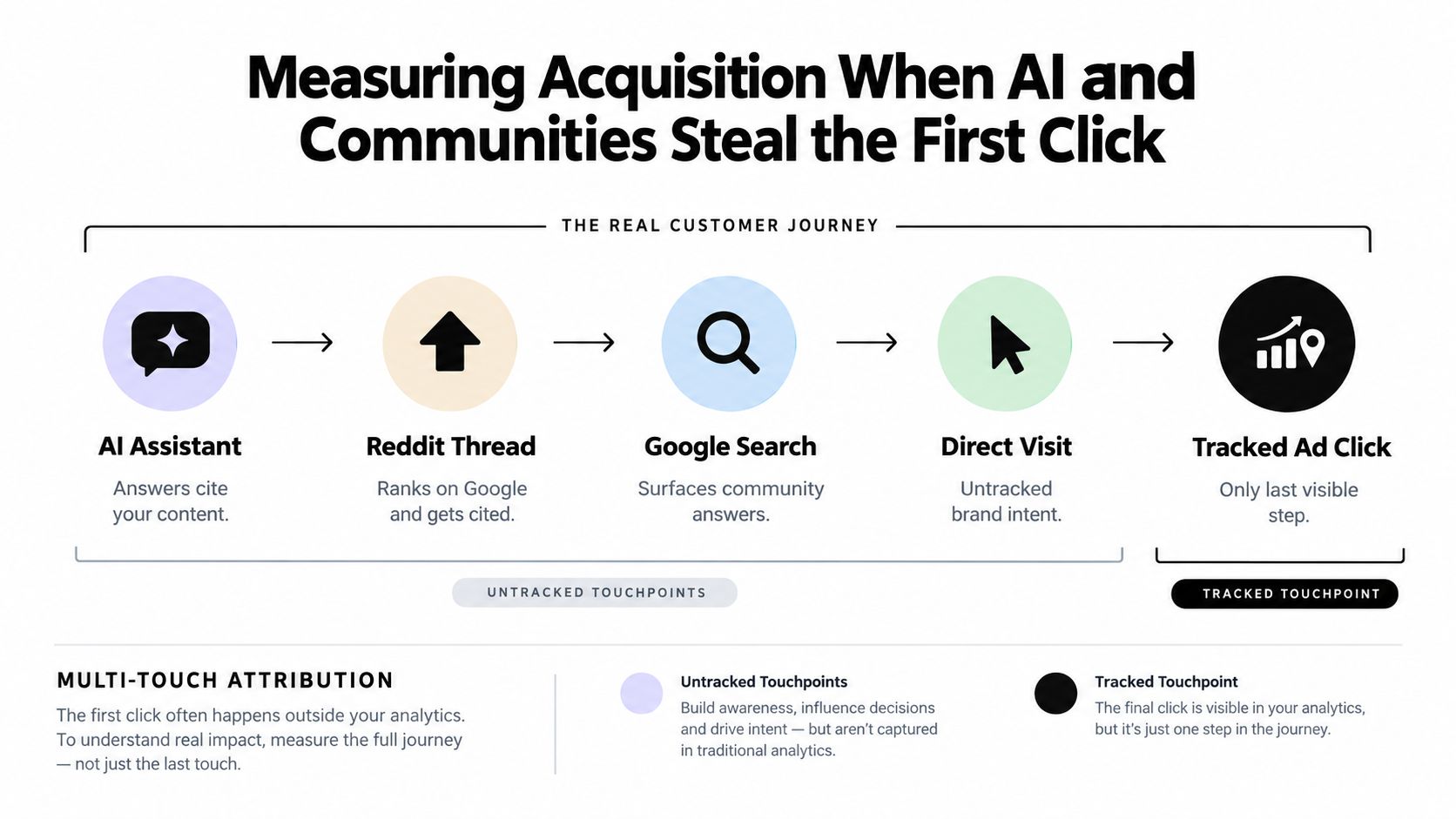
Last-click attribution is becoming a crutch. Buyers increasingly discover products through AI answers, review sites, and community threads before they ever hit a tracked landing page. That means the first meaningful exposure can happen in a place your analytics stack barely sees.
A 2025 G2 buyer-behavior report indicates that AI-search leads show higher conversion rates than traditional research leads, and that AI search and software-review sites have overtaken some conventional sources among enterprise buyers (Widelly summary of the G2 report). That matters because the final click is no longer the same thing as the first influence.
What to measure instead
Track assisted conversions, branded-search lift, direct traffic, self-reported attribution, and pipeline quality together. If a channel creates more branded demand and better sales conversations, it's doing acquisition work even when the last touch is elsewhere. Don't let a neat dashboard hide a messy buying journey.
The practical mistake is over-crediting whatever received the tracked click. That rewards the wrong channel and pushes budget away from the surfaces where buyers first formed trust. Once that happens, you optimize toward a reporting artifact instead of actual demand creation.
The internal lesson is blunt. If a Reddit thread, review page, or AI answer keeps showing up in buyer journeys, treat it like a real demand surface and instrument it accordingly. The source of demand is not always the source of the click.
Measure what creates confidence, not just what creates traceable sessions.
If your reporting can't show how community and AI surfaces influence pipeline, your scaling decisions will stay distorted. That doesn't mean attribution is useless. It means attribution needs to sit underneath a wider view of how buyers decide.
Your 30-Day Founder Acquisition Plan
Week one is about honesty. Map your current funnel, calculate payback on a gross-margin basis, and separate channels by source instead of blending them together. If you can't see channel-level economics, stop spending on scale until you can.
Week two is about focus. Pick two channels that match your stage, one compounding and one direct. If you're early, that usually means one community or content motion and one faster feedback channel like outbound or paid retargeting.
Week three is about fixing the bottleneck. If activation is weak, improve onboarding, trial experience, and product clarity before adding more traffic. If retention is weak, stop pretending acquisition can outrun churn.
Week four is about decision rules. Set a payback target that matches your runway and stage, then decide what gets cut if the channel misses. A 2025 benchmark of 372 SaaS companies found median CAC payback of 16.8 months at seed, 14.2 at Series A, 12.7 at Series B, and 11.3 at Series C and later, which is a strong signal that payback targets should be stage-specific, not universal (Pavilion Benchmarkit 2025 SaaS Performance Benchmarks).
What to own each week
- Owner, week one: you. Output, a live payback tracker with channel-level CAC and gross margin.
- Owner, week two: you. Output, a two-channel plan with one test per channel and a clear pass-fail rule.
- Owner, week three: you. Output, an activation or retention fix list ranked by expected payback impact.
- Owner, week four: you. Output, a stop-loss rule for underperforming spend and a shortlist of what to double down on.
If the metrics miss, cut scope before you cut focus. The answer is rarely “do more.” It's usually “do fewer things, with better economics.”
Founder Questions That Come Up After Reading This
If you're wondering when to hire growth help, do it after you've proven one channel can repay its own cost on a sensible timeline. Before that, a hire mostly increases coordination overhead. A contractor can help with execution, but only if you already know what good looks like.
What kills retention-led growth is weak product value after the first win. If users don't reach a clear aha moment quickly, no amount of acquisition cleverness will save the model. That's why activation sits upstream of everything else.
Community versus paid is a cash question, not a philosophy question. If attribution lags and runway is tight, community often wins because it can create trust and pipeline without the same upfront cash drain. Paid wins when you already know the unit economics are healthy and you want to buy speed.
A realistic founder-stage payback target depends on runway, but the benchmark data shows why universal rules are lazy. For a $99/month plan with 80% gross margin and $300 CAC, payback is about 3.8 months, while at 50% gross margin it stretches to about 6.1 months (Pavilion benchmark report). Use that kind of math, not generic advice, to decide what you can safely scale.
Bazzly helps founders turn Reddit into a repeatable acquisition channel by monitoring relevant threads, drafting context-aware replies, and surfacing high-intent conversations fast. If you want a community motion that fits the cash-efficiency reality of early-stage SaaS, visit Bazzly and see how the workflow maps to your market.


