How to Reduce Customer Acquisition Costs with 7 Levers
Your campaigns are generating more clicks. Signups look healthy in the dashboard. Yet you're still watching the bank balance because too few customers pay, too many need hands-on help, or they leave before you recover what you spent.
If you're figuring out how to reduce customer acquisition costs, don't start by negotiating cheaper traffic. Start by finding where you're paying for customers who never become economically valuable. Then fix that constraint before increasing spend.
Table of Contents
- Why Lowering CAC Requires a Full Funnel View
- Establish the Real Customer Acquisition Cost Baseline
- Target Customers With Higher Purchase Intent
- Choose the Right Lever for Your Funnel
- Improve Onboarding and Retention Before Buying More Traffic
- Create Durable Discovery and High-Intent Distribution
- Verify CAC Reductions With Better Experiments
Why Lowering CAC Requires a Full Funnel View
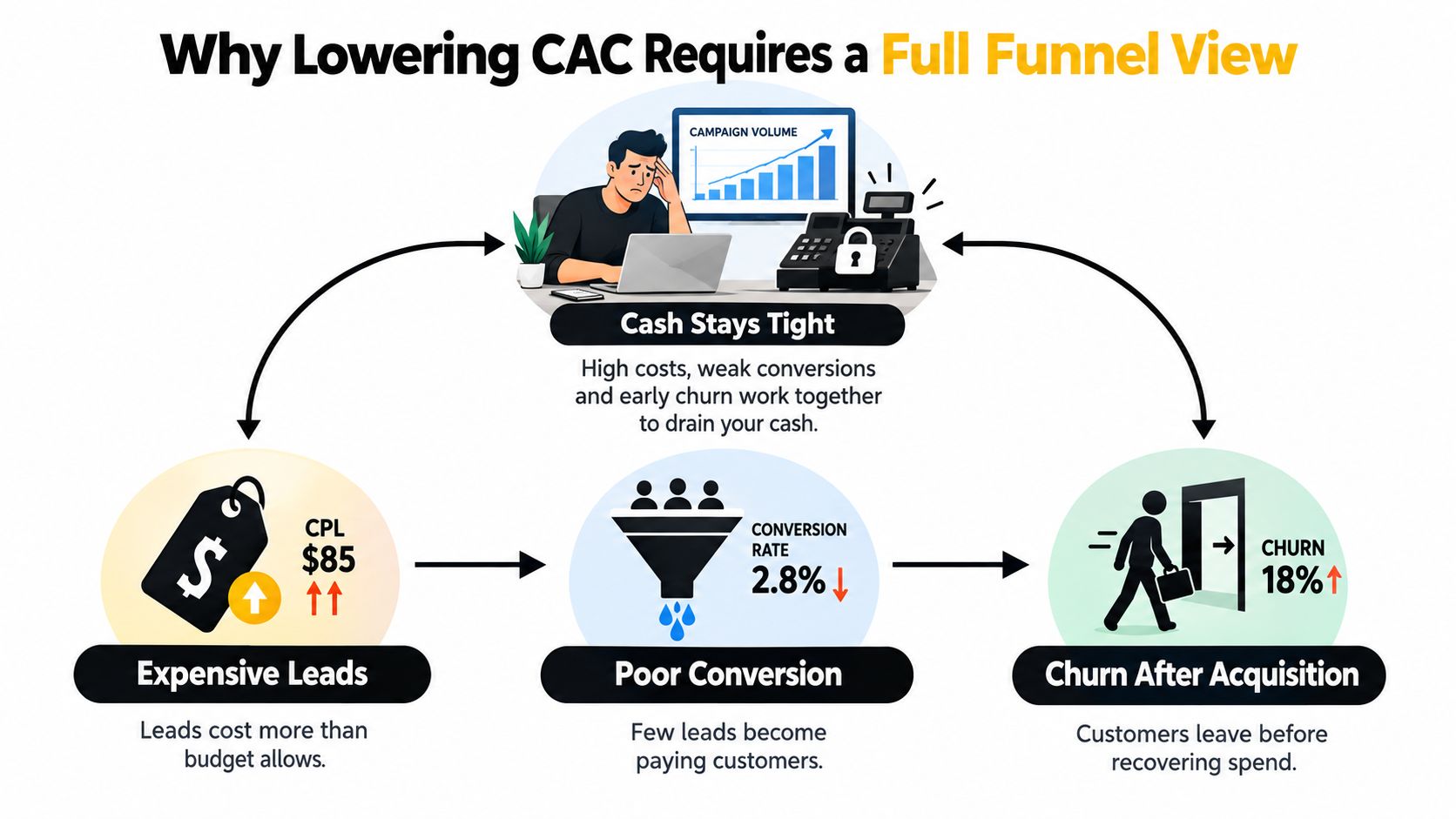
Cheap leads aren't the same as efficient acquisition. A campaign can produce inexpensive signups while sending your sales team prospects who can't use the product. Another can attract fewer customers at a higher initial cost but recover that investment through stronger margins and longer relationships.
Treat CAC reduction as an operating system with seven levers: targeting, conversion, retention, channel allocation, automation, experimentation, and measurement. Each addresses a different source of waste. Optimizing one while ignoring the others can move costs elsewhere.
The diagram connects the problems that keep a founder short of cash despite growing campaign activity.
Diagnose the constraint before changing the campaign
Start with the customer journey, not the advertising account. For help mapping the stages and handoffs, use the sales funnel strategy from Alpha Omega Digital as a planning resource. Add activation and retained revenue to your own map so the analysis doesn't stop at purchase.
Ask where qualified prospects stall and who must intervene to move them forward.
- Before signup: Are you attracting people with an urgent problem your product solves?
- Before payment: Does the buying experience explain the value, requirements, and price?
- After purchase: Can customers achieve the promised outcome without excessive assistance?
- Across operations: Are people spending time on repetitive work that could be automated safely?
Practical rule: Fix the most expensive constraint, not the metric that's easiest to change.
Don't launch every improvement simultaneously. Choose the bottleneck that most directly limits profitable growth, assign an owner, and establish what evidence would justify further investment. That gives a small team a focused operating priority instead of an expanding marketing checklist.
Establish the Real Customer Acquisition Cost Baseline
Calculate customer acquisition cost as total acquisition-related marketing and sales spending divided by new paying customers. A trial signup isn't a paying customer, and an advertising platform's reported acquisition cost isn't necessarily your business's CAC.
Build an acquisition ledger that includes advertising, acquisition software, creative production, agency fees, commissions, and the relevant share of employee time. If you write every community reply yourself, record that effort rather than calling the channel free.
Separate the business view from the channel view
Use blended CAC to understand overall spending efficiency. Then separate self-serve customers from sales-assisted customers and group results by acquisition source, customer size, and acquisition cohort.
Keep your cost-allocation method consistent. Shared creative and software expenses shouldn't disappear merely because they're difficult to assign. Put them in a visible shared-cost category and document how you distribute them.
A spreadsheet is enough to start. Use the customer acquisition cost calculator to organize the arithmetic, and treat Excellorix's discussion on CAC reduction as a supplementary diagnostic resource rather than a substitute for your own ledger.
| Metric | What it tells you | Decision it supports |
|---|---|---|
| Blended CAC | Overall acquisition spending per new customer | Whether your growth plan fits available cash |
| Segment CAC | Acquisition cost for a defined customer group | Which audiences deserve further investigation |
| Gross-margin payback | How long gross profit takes to recover CAC | How much acquisition spending you can finance |
| Cohort retention | Whether acquired customers continue paying | Whether an apparent winner deserves more budget |
Calculate payback using gross profit
Gross-margin CAC payback = CAC ÷ (monthly revenue per customer × gross margin). Don't use revenue alone, because money needed to deliver the service isn't available to repay acquisition spending.
For example, a $99-per-month product with a 75% gross margin generates $74.25 in monthly gross profit, so a $300 CAC implies roughly 4.0 months of payback, before additional support or expansion considerations, using the gross-margin payback framework in the SaaS benchmarks.
Treat that calculation as an estimate, not a guarantee. It assumes the customer continues paying and the economics remain comparable.
Your investment rule should be explicit: continue funding a segment only when its expected payback fits your cash constraints and observed customer behavior supports the estimate. Don't let a strong blended average conceal a segment that requires expensive sales assistance and leaves early.
Target Customers With Higher Purchase Intent
A large audience is useful only when enough people in it have a reason to buy. Start with your successful customers and identify the circumstances that made your product relevant, not merely their job titles or company categories.
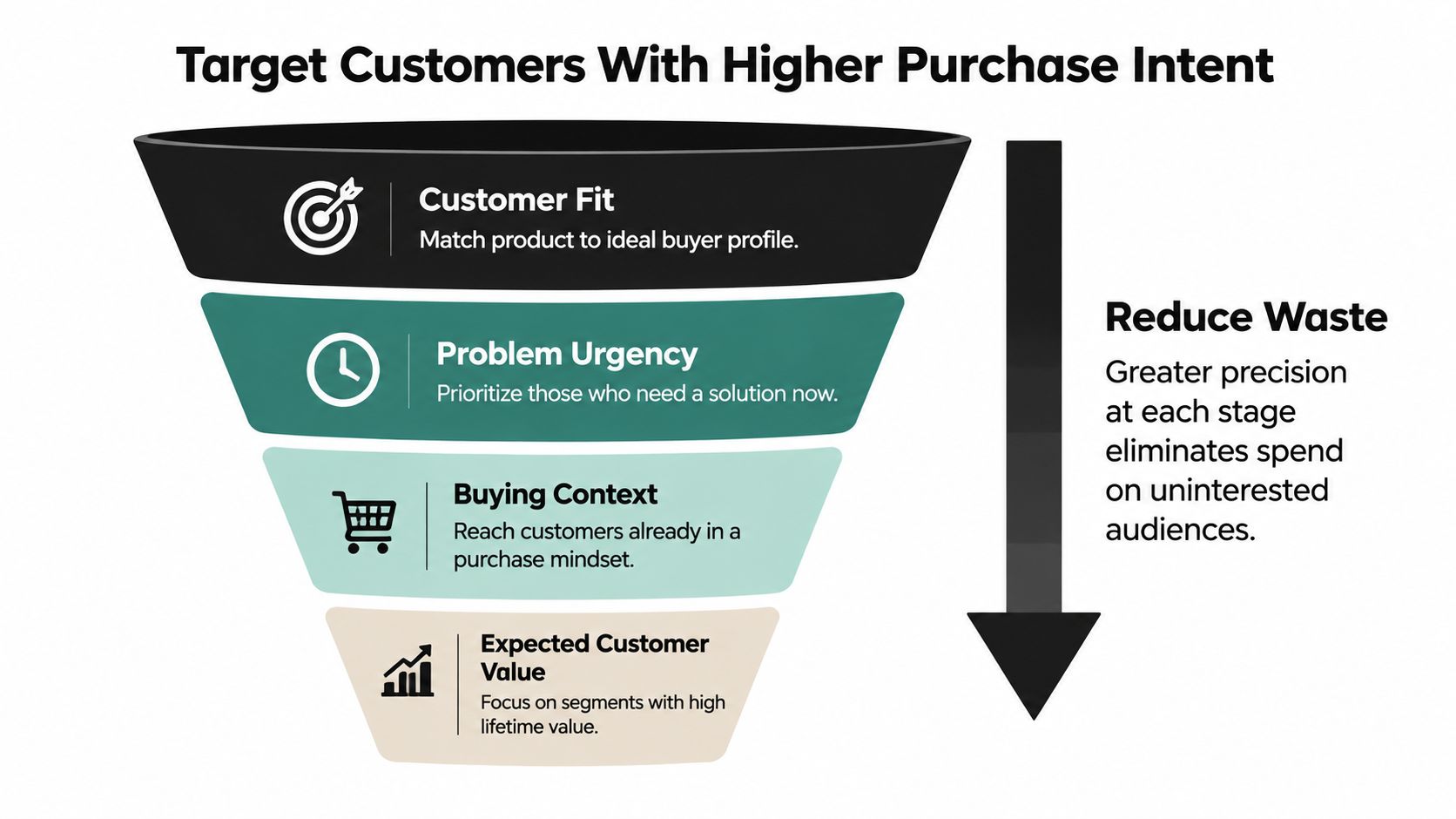
Look for the intersection of fit, urgency, buying context, and expected customer value. A founder browsing productivity discussions and a founder actively replacing an unsuitable workflow tool may resemble each other demographically. They need different messages and different levels of attention.
Use this funnel to screen opportunities before spending time or money reaching them.
Read the buying situation
Consider a hypothetical SaaS team selling client reporting software. Posting a generic product pitch in a large entrepreneurship subreddit tells the team little about who needs the product.
A thread asking how to replace manual client reports provides a more useful starting point. The team can assess the current workflow, required integrations, budget constraints, and dissatisfaction before deciding whether a recommendation belongs there.
- Customer fit: Can the product support the workflow without workarounds or custom development?
- Problem urgency: Is the person resolving an active obstacle or collecting ideas?
- Buying context: Are they comparing options, requesting recommendations, or describing replacement criteria?
- Expected value: Does this use case resemble customers who adopt successfully and remain satisfied?
Use the Reddit buying-intent study as a starting point for examining conversation signals. Validate your own selection criteria against what prospects subsequently do.
Qualify before recommending
Read the full thread and community rules. Answer the question directly, disclose your connection when recommending your product, and explain limitations that matter to the buyer.
For an accompanying discussion of acquisition tactics, watch the video below.
Apply the same selection logic to search keywords, partnerships, and outbound lists. Favor language that describes a problem, switching event, or requirement over broad category interest.
Narrow targeting introduces a trade-off: you'll have fewer opportunities to evaluate. Preserve learning by recording why each prospect qualified or didn't, then broaden into adjacent use cases deliberately. Don't abandon a well-defined audience because a broader campaign produces more activity.
Choose the Right Lever for Your Funnel
Suppose a small B2B software company buys relevant search traffic, but visitors rarely start a trial. The founder's first instinct is to find a cheaper channel. That may leave the actual problem untouched: the advertisement promises a specific workflow improvement, while the landing page describes the entire product.
Fix message-to-page continuity before purchasing more exposure. Show the promised workflow, explain who it suits, provide relevant evidence, and make the next action obvious. Keep your promise narrow enough that the product can fulfill it.
Compare interventions by their economic mechanism
When acquisition spending is unchanged, more paying customers reduce CAC mathematically. But the intervention that creates those customers determines whether the improvement is sustainable.
Qualified traffic addresses an audience shortage. It makes sense when the existing buying journey works for suitable prospects but too few reach it. The trade-off is additional spending and the risk that expansion brings weaker-fit visitors.
Conversion work addresses a buying obstacle. It's appropriate when suitable prospects arrive but hesitate because pricing is unclear, proof is irrelevant, or signup requires unnecessary effort. The risk is removing useful qualification and attracting customers who shouldn't buy.
Retention work addresses post-purchase economics. It doesn't retroactively change recorded acquisition spending, but it can improve the return from that spending and reduce replacement demand. The trade-off is diverting product and support capacity from other work.
Don't call every improvement a lower CAC. Distinguish a lower acquisition cost from a better return on acquisition spending.
Match the fix to observed behavior
Review actual journeys rather than guessing from aggregate rates. Read sales objections, inspect landing-page paths, and watch where new users stop.
If customers buy but never complete setup, another landing-page rewrite is unlikely to solve the core problem. If successful customers consistently arrive from a specific workflow query, broader reach may be appropriate only after you've exhausted closely related demand.
Choose a primary intervention and leave the rest stable enough to interpret the result.
| Observed bottleneck | Intervention | Economic relationship | Main trade-off |
|---|---|---|---|
| Suitable visitors are scarce | Expand closely related targeting | Acquisition spend ÷ new paying customers | Broader reach may weaken fit |
| Qualified visitors hesitate | Improve page continuity, proof, and signup | Same spending spread across more buyers | Easier signup may reduce qualification |
| Buyers fail to reach value | Repair activation and support | More gross profit recovered per acquired customer | Requires product or service capacity |
| Customers succeed but acquisition is labor-intensive | Simplify repetitive execution | Less operating cost per acquired customer | Automation needs supervision |
Improve Onboarding and Retention Before Buying More Traffic
A customer who pays and then gets stuck isn't an acquisition success you can safely scale. You've bought an opportunity to deliver value, not completed the economic job.
The historical evidence is substantial but context-dependent: Bain reported that increasing customer retention rates by 5% can increase profits by 25% to 95%, depending on industry and business economics, in its research on customer loyalty and profitability. Treat that as a reason to examine retention, not a forecast for your SaaS company.
Define activation as a customer outcome
Don't confuse a completed product tour with activation. Define the earliest observable event that demonstrates useful progress for the buyer.
For client reporting software, that might mean generating a usable report from connected client data. Opening the dashboard or clicking through onboarding screens wouldn't meet the same standard.
Work backward from that outcome. Remove setup requests that aren't necessary yet, provide realistic sample material where appropriate, and offer assistance at the specific step where users struggle.
- Inspect failed setups: Identify missing permissions, unavailable integrations, unclear instructions, and unsupported use cases.
- Trigger relevant assistance: Send guidance based on incomplete actions rather than a generic welcome sequence.
- Review support patterns: Fix recurring product confusion instead of repeatedly answering the same question.
- Prepare for renewal: Check whether the customer has achieved the promised outcome before discussing another term.
- Earn expansion: Recommend additional usage only when it addresses a demonstrated need.
Connect customer success to acquisition decisions
Compare cohorts at equivalent stages in their lifecycle. A recently acquired group hasn't had the same opportunity to renew or cancel as an older one.
Track time-to-value, gross revenue retention, and net revenue retention alongside the acquisition baseline. Gross revenue retention highlights revenue lost through churn and contraction; net revenue retention also reflects expansion within the existing customer base.
A cheaper customer isn't necessarily a better customer if they leave before the relationship pays back.
Use cancellation reasons to separate targeting failures from delivery failures. A customer who required an unsupported integration may never have belonged in the pipeline. A suitable customer who couldn't understand setup points to a different intervention.
Give marketing that distinction. Otherwise, the team may keep acquiring the wrong use case while product managers spend time trying to rescue it.
Create Durable Discovery and High-Intent Distribution
Consider a hypothetical founder who repeatedly hears the same buying question: can the product replace a spreadsheet-based client reporting process without disrupting existing integrations? Instead of commissioning broad awareness content, the founder builds a practical comparison around that decision.
The page explains migration requirements, workflow differences, limitations, and which buyers should keep their current setup. The founder then adapts the same knowledge into a community answer and follow-up material for prospects who request more detail.
That's a manageable discovery strategy for a small team. Create useful buying guidance, then distribute it where the question already exists.
Build around recurring purchase questions
Online research isn't a recent addition to buying behavior. In Google's 2011 Zero Moment of Truth study, 84% of surveyed shoppers used online research sources before purchasing, according to its research into pre-purchase information seeking.
That's historical consumer research, not a current SaaS conversion benchmark. Its practical relevance is the role of information before purchase: your content should help someone make a decision, not merely introduce your company.
Start with questions collected from sales conversations, support tickets, relevant Reddit threads, and customer interviews.
- Replacement questions: Explain switching effort, migration constraints, and reasons not to switch.
- Compatibility questions: Show the supported workflow and disclose integration limitations.
- Comparison questions: Compare meaningful buying criteria rather than declaring your product the winner.
- Implementation questions: Explain what the customer needs before they can achieve value.
Make each asset useful without requiring signup. Include a relevant next action, but don't hide the essential answer behind a lead form.
Distribute with context rather than repetition
A comparison page and a Reddit reply shouldn't read alike. The page can address the full decision; the reply should answer the person's specific question in the language of that conversation.
Link only when the destination adds something useful. If your product isn't a fit, explain the alternative approach rather than forcing a recommendation.
The guide to generating website traffic from Reddit can help shape your distribution workflow. Keep community participation accountable to relevance, disclosure, and the rules of each community.
Maintain a small question library with the buyer's wording, the underlying requirement, the appropriate asset, and any limitations. Update existing material when prospects reveal missing information instead of publishing another page covering the same ground.
Allocate budget using customer quality
Suppose the team is testing paid search, community participation, and a complementary partner's newsletter. Paid search generates the most visible activity, while community prospects ask more detailed implementation questions.
Neither observation is enough to declare a winner. Compare the cohorts using the baseline already established: acquisition cost, activation, gross-margin payback, and retained revenue.
Include production and participation time in the comparison. Content and community work can reduce dependence on paid impressions, but neither is costless.
Move budget gradually toward the audience-channel combination supported by mature customer outcomes. Keep a smaller exploration budget for adjacent opportunities so efficiency doesn't become an excuse to stop learning.
| Operating decision | Keep visible | Avoid |
|---|---|---|
| Continue an asset | Qualified inquiries and useful buying conversations | Keeping it solely because it attracts visits |
| Increase a channel's budget | Cohort quality and affordable payback | Scaling from lead price alone |
| Retire an experiment | Clear mismatch or an uneconomic delivery model | Ending it solely because results take longer to observe |
| Expand distribution | A relevant audience with an unanswered question | Reposting the same promotion everywhere |
Automate preparation and repetitive execution
Use automation for keyword monitoring, conversation alerts, tagging, reporting, and assembling material for review. Keep positioning, sensitive replies, and suitability decisions under human supervision.
A practical workflow sends relevant conversations into a shared review queue, attaches the matching question-library entry, and records the decision to respond or decline. Google Sheets can hold the opportunity log; your CRM can connect qualified conversations to subsequent customer outcomes.
Judge automation by useful work saved, not messages produced. Review false-positive alerts, correct poor classifications, and remove workflows that create more supervision than they eliminate.
Before expanding an automated process, confirm that someone owns its rules, exceptions, and quality checks. Otherwise, you may reduce visible marketing labor while increasing support work or damaging trust.
Verify CAC Reductions With Better Experiments
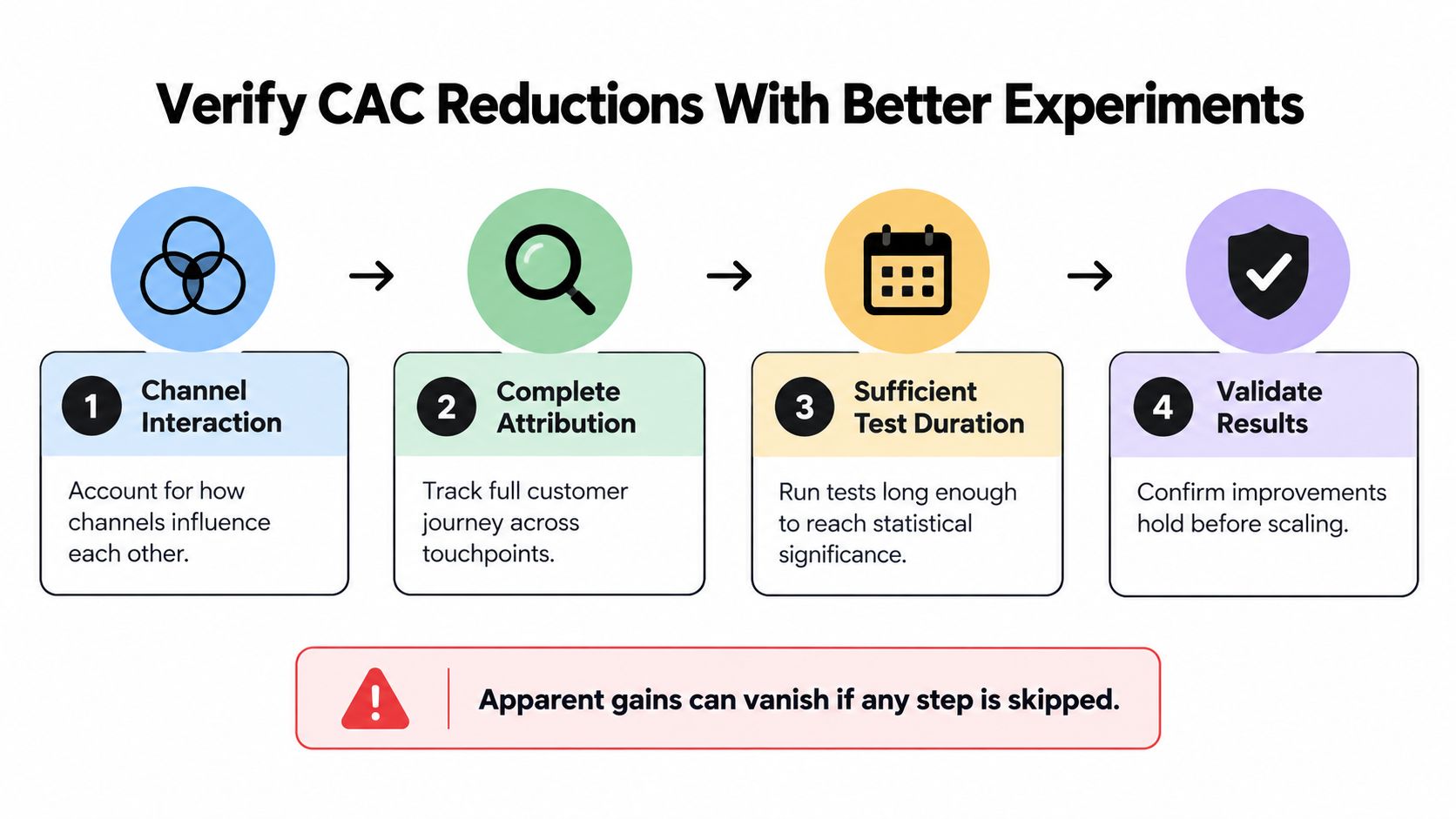
A dashboard showing lower CAC doesn't establish that your change caused it. Customers may have encountered another campaign, the audience may have shifted, or conversions may have arrived from work completed earlier.
Measurement is a decision problem, not just a reporting problem. You need enough evidence to choose whether to continue, change, or stop spending. You don't need to pretend that every customer journey is fully observable.
Use the process below as a validation checklist, not a promise that complete attribution is attainable.
Define success before launching
Instrument the journey from qualified visit through activation, payment, and retained revenue. Choose a primary business metric, such as gross-profit CAC payback, and monitor guardrails including lead quality, refunds, churn, and service workload.
For controlled tests, randomly assign eligible users to treatment and control. Predefine the minimum economically worthwhile effect, required sample size, and observation window. Don't stop when an attractive result first appears.
Google recommends examining the point estimate, margin of error, and p-value; the conventional significance standard is a p-value below 0.05 with a confidence interval excluding zero, as described in its experiment reporting guidance. Statistical significance still doesn't prove the improvement is large enough to matter commercially.
Avoid simultaneous changes that prevent interpretation. A new audience, landing page, price, and onboarding sequence launched together won't tell you which intervention deserves credit.
Make decisions despite incomplete attribution
In an app-attribution survey covered by MediaPost, only 18% of marketers were very confident they could match installs to the correct source, while 82% reported partial clarity, according to its report on attribution confidence. That survey isn't a SaaS-specific benchmark, but it illustrates why precise-looking attribution deserves scrutiny.
Combine channel cohorts, signup discovery questions, and assisted-conversion records. Ask customers how they first encountered you and what influenced their decision, recognizing that memory is imperfect.
Where practical, retain a holdout group. Estimate incremental CAC by dividing additional marketing and sales cost by additional paying customers, and check whether a channel created demand or merely received credit for an existing buyer.
Decision standard: Scale only when the economics improve without unacceptable damage to customer quality.
Use a focused month-long sequence
Don't promise a conclusive result within a calendar deadline if your buying cycle or sample size won't support it. Use the month to establish a disciplined process.
- Establish the baseline: Reconcile acquisition costs, paying customers, and cohort definitions.
- Choose the bottleneck: Select the constraint with the clearest economic consequence.
- Run a controlled change: Document the hypothesis, primary metric, guardrails, and stopping rule.
- Review before scaling: Expand only when the planned observation supports the result; otherwise, continue observing or revise the hypothesis.
Your next action isn't to buy more traffic. It's to identify the acquisition decision you can improve with evidence you can realistically collect.
For a Reddit-focused acquisition option, Bazzly monitors relevant conversations and helps identify high-intent threads with context-aware reply drafting. Visit the platform to evaluate whether it fits your workflow, then test it against the same customer-quality and payback standards you apply to every channel.


